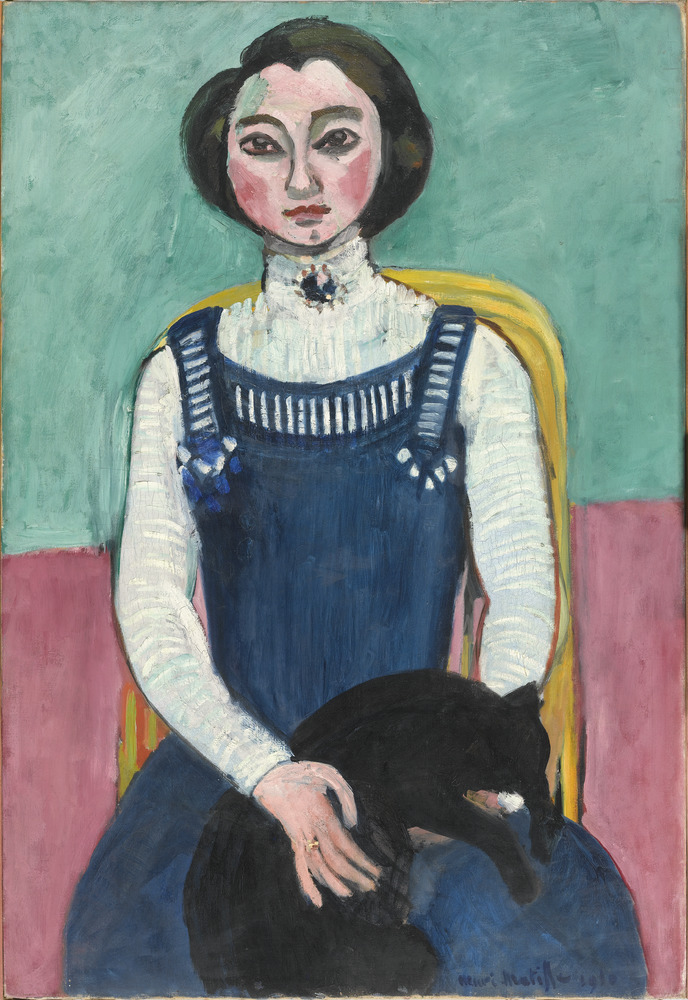
Henri Matisse. Marguerite au chat noir. 1910
Flagship work of the exhibition Henri Matisse. Marguerite au chat noir [“Marguerite with the Black Cat”]. 1910. Oil on canvas, 94 × 64 cm. Centre Pompidou, Paris — gift, 2013. Source: Wikimedia Commons.

Chez Matisse

The Legacy of a New Approach to Painting

CaixaForum Barcelona27 March — 16 August 2026

Matisse was the first to let colour off the leash. Before him, paint always had to depict something — a face, a fold of fabric, the shadow of a vase. He made blue simply blue, at full strength, and the painting turned out to need nothing more. In 1905 they called him a “wild beast” for it (fauve in French — hence Fauvism). Twenty years later, everyone was painting that way.

Chez Matisse at CaixaForum Barcelona is about how he got there and who followed. Around 95 works from the Centre Pompidou in Paris: Matisse himself and the artists around him. The paintings are hung chronologically, and you can watch him gradually strip things away. By the end of his life he was barely painting at all — he cut figures from coloured paper with scissors.

Honestly — I went in without much in the way of expectations and came out genuinely moved. I wanted to hold onto that feeling and share it. Here are the paintings that stayed with me most, with a few words on each.

On the cover — Marguerite au chat noir (1910). The artist’s daughter Marguerite (fifteen here), shown in a solemn frontal pose — like saints on old icons. A high collar and brooch hide the scar from a tracheotomy (throat surgery she had as a child to save her life). The painting travelled to the Armory Show in New York as early as 1913 — the event that launched the history of American modern art. It entered the Centre Pompidou as a gift in 2013. At Chez Matisse it is the face of the exhibition.

Gallery

Line and Colour

1900 — 1906

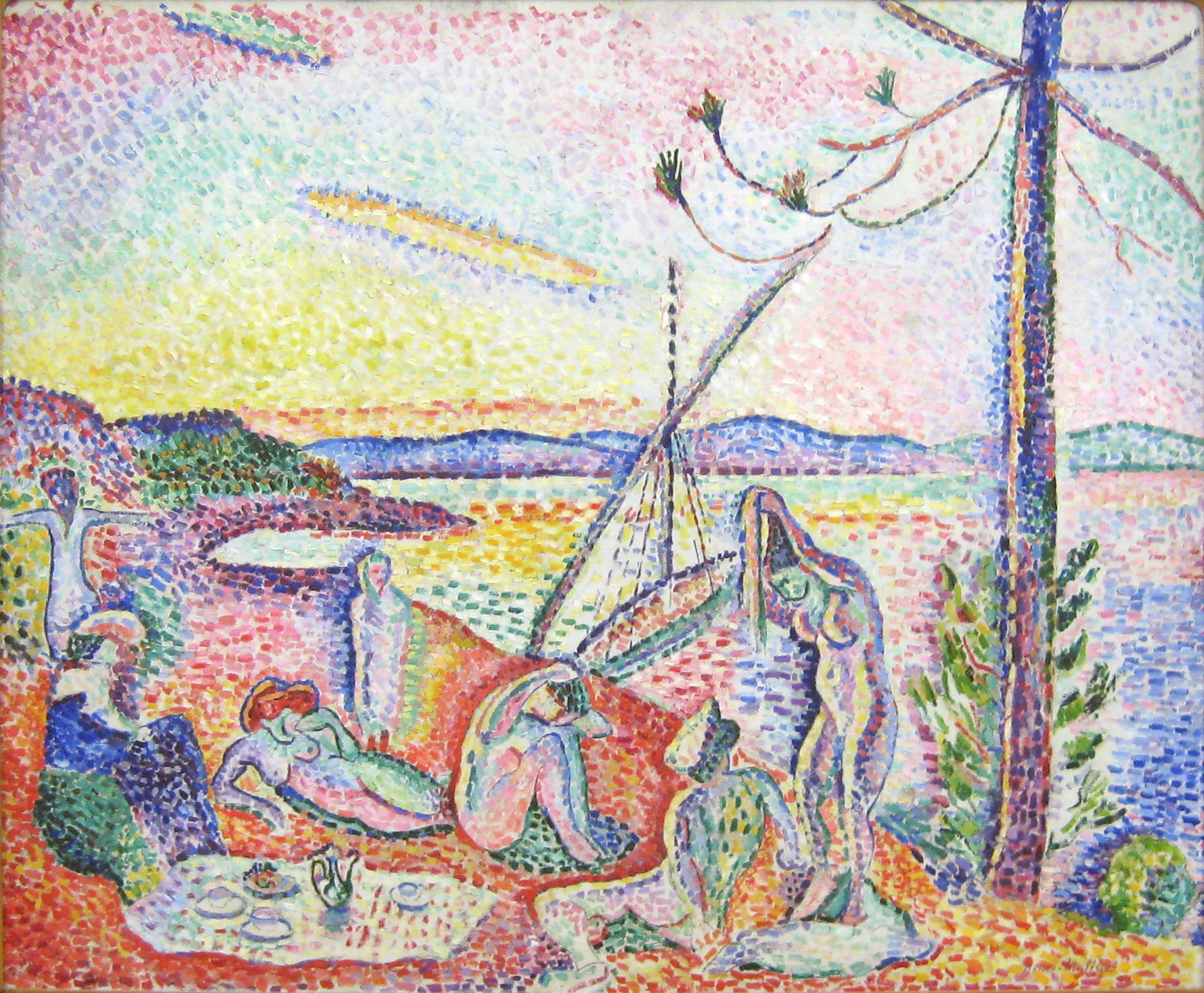
In the late 1890s Matisse was still a student, studying with Gustave Moreau at the École des Beaux-Arts in Paris — the very studio from which all the future Fauves would emerge. In the summer of 1904 he spent time in Saint-Tropez with Paul Signac and tried divisionism — a technique in which pure colours are laid down as separate dots side by side, without mixing on the palette; the blending is meant to happen in the viewer’s eye. Back in Paris, he painted Luxe, calme et volupté in his studio. The following summer André Derain joined him in Collioure near the Spanish border. The harsh southern light pushed Matisse to build the canvas with colour itself — a saturated palette in which tones sit next to each other in bright strokes. The paintings he showed at the Paris Salon d’Automne in 1905 — alongside works by Derain, Camoin, Marquet and Vlaminck — shocked critics with their “brutal” handling of colour.

From this point Matisse was called the leader of a movement that quickly found a devoted audience. In 1906–1907 Georges Braque, Béla Czóbel, Kees van Dongen and Sonia and Robert Delaunay, among others, began developing their own visual languages, inspired by Fauvist colour and Expressionism. Matisse himself summed up the Fauvist revolution with disarming clarity: “A Fauve painting is a luminous block formed by the harmony of several colours.”

A Fauve painting is a luminous block formed by the harmony of several colours.
Henri Matisse

Key works

Henri Matisse. Luxe, calme et volupté. 1904
Centre Pompidou · Wikimedia Commons

Henri Matisse. Luxe, calme et volupté

“Luxury, Calm and Pleasure” · 1904 · Oil on canvas · 98.5 × 118.5 cm · Centre Pompidou

The title comes from a line by Baudelaire (“Invitation to the Voyage”). It is essentially a report on the summer with Paul Signac in Saint-Tropez. The painting is done in divisionist dots — but Matisse’s dots are larger and rougher than Signac’s, the figures simplified almost to outline, and the Mediterranean beach turned into a timeless idyll: bathers, a cloth spread on the sand. Here you can already see how Matisse adapts someone else’s method to his own purpose — the dots are not for optical trickery but to free colour from the obligation to describe reality. A year later he would abandon the dotted technique, but the main idea — “building space with pure colour” — he took with him to Collioure. From it, within a few months, Fauvism would be born.
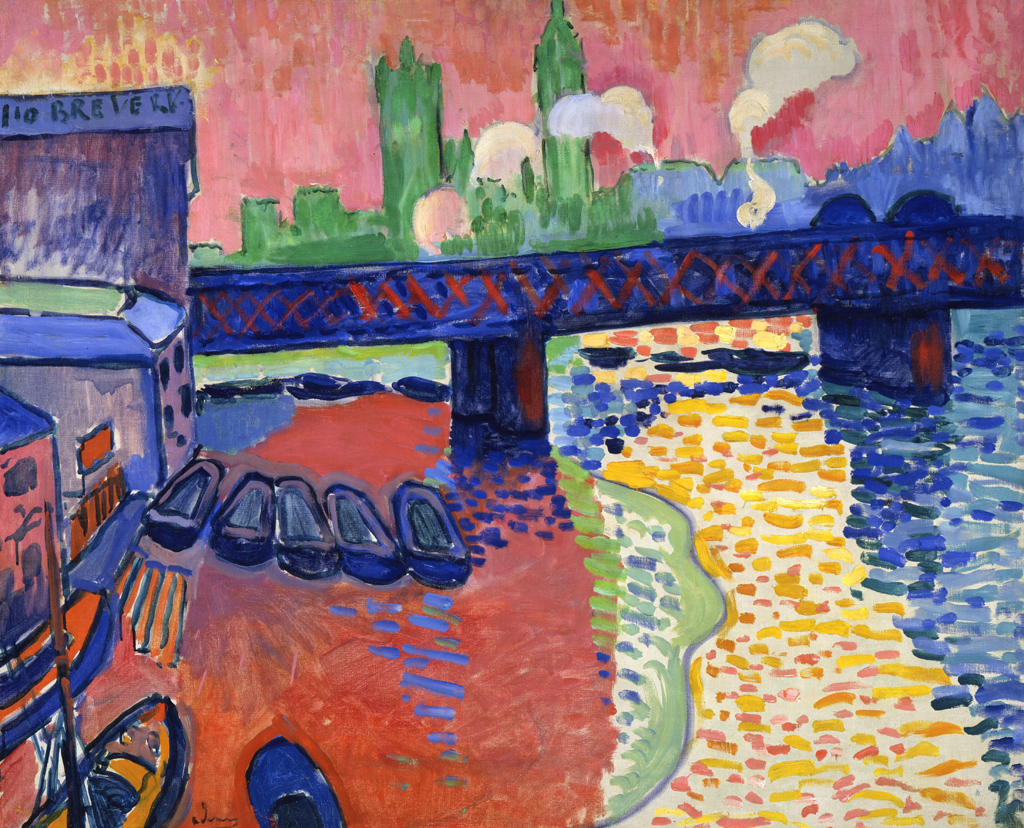
André Derain. Charing Cross Bridge, London. 1906
National Gallery of Art, Washington · Wikimedia Commons

André Derain. Charing Cross Bridge, London

“Charing Cross Bridge, London” · 1906 · Oil on canvas · 80.3 × 100.3 cm · National Gallery of Art, Washington

The painting is the result of three London trips Derain made in 1906. Dealer Ambroise Vollard sent him to London on the model of Monet’s “London series”: to see how the same motif could be seen anew. But where Monet’s Thames dissolves in fog, Derain’s bursts into flame: the water becomes a turquoise-pink band, the sky gold, the bridge a lilac graphic arc. Such colour cannot be seen in reality — it can only be constructed — it conveys not the object itself but the sensation of it. Derain strips the Impressionist haze from the landscape and turns London into a decorative plane where colour no longer has to repeat reality. The main point here — Fauvism turns out not to be Matisse’s personal style but a shared language: one summer in Collioure — and a year later two artists are already working in the same direction.

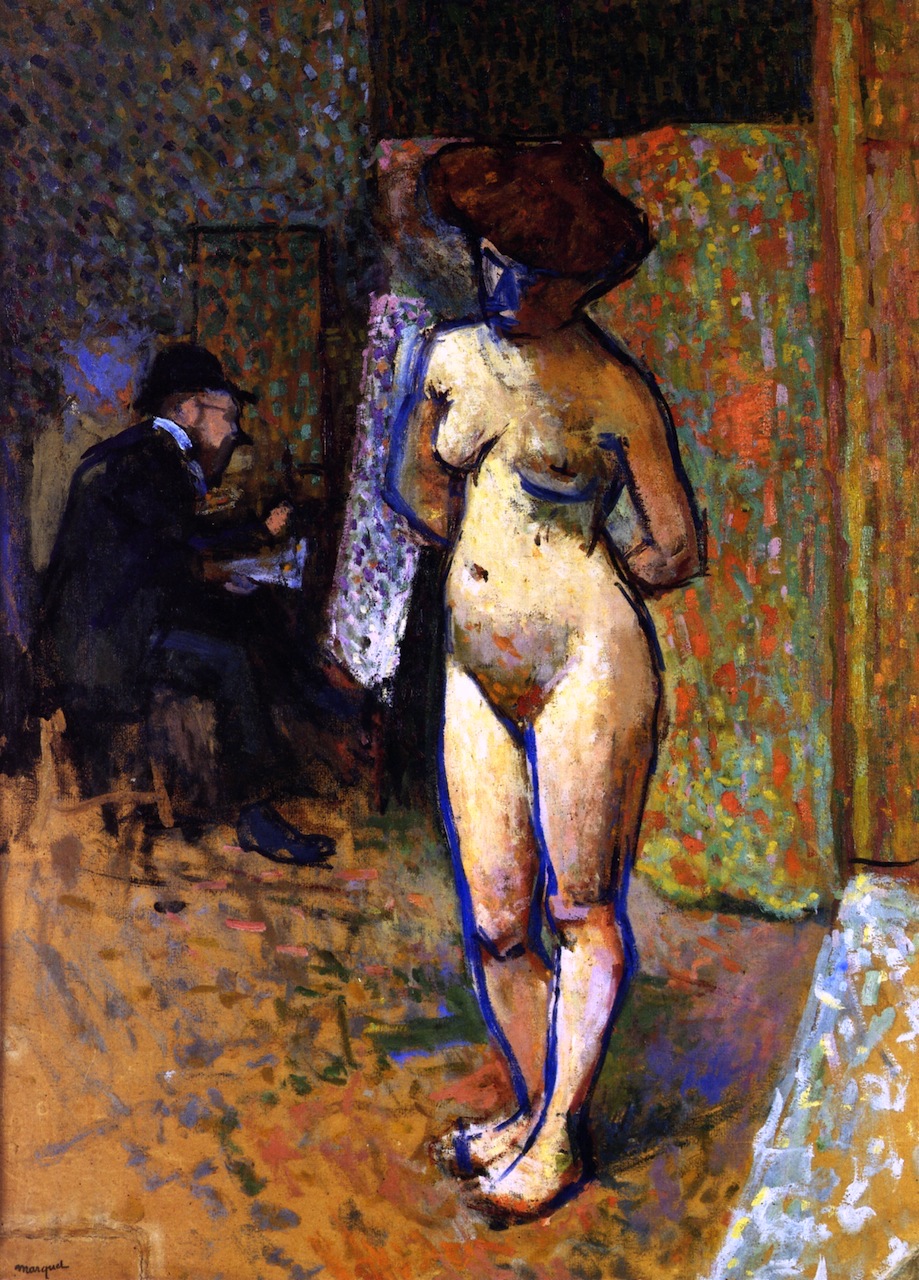
Albert Marquet. Matisse dans l'atelier de Manguin. 1904—1905
Centre Pompidou, MNAM (AM 3488 P) · Wikimedia Commons

Albert Marquet. Matisse dans l'atelier de Manguin

“Matisse in Manguin's Studio” · 1904—1905 · Oil on canvas · 100 × 73 cm · Centre Pompidou

After Gustave Moreau's death in 1898, Matisse and Marquet moved to the studio of their fellow student Henri Manguin at 61 rue Bourgoin. In the winter of 1904—1905, the three friends arranged a session with a nude model — and each painted his own version of the evening. Marquet chose not the model but Matisse himself at work: the artist's dark silhouette appears on the left, back to us, with a canvas on an easel between him and the model. The painting is documentary, without Fauvist colour shock — and that is precisely what makes it valuable: Fauvism was born not in the solitude of a genius but in a shared studio where artists watched each other paint and picked up techniques. At the exhibition this work sets the tone for the entire first gallery — before becoming a “wild beast”, Matisse was part of a small circle of colleagues.

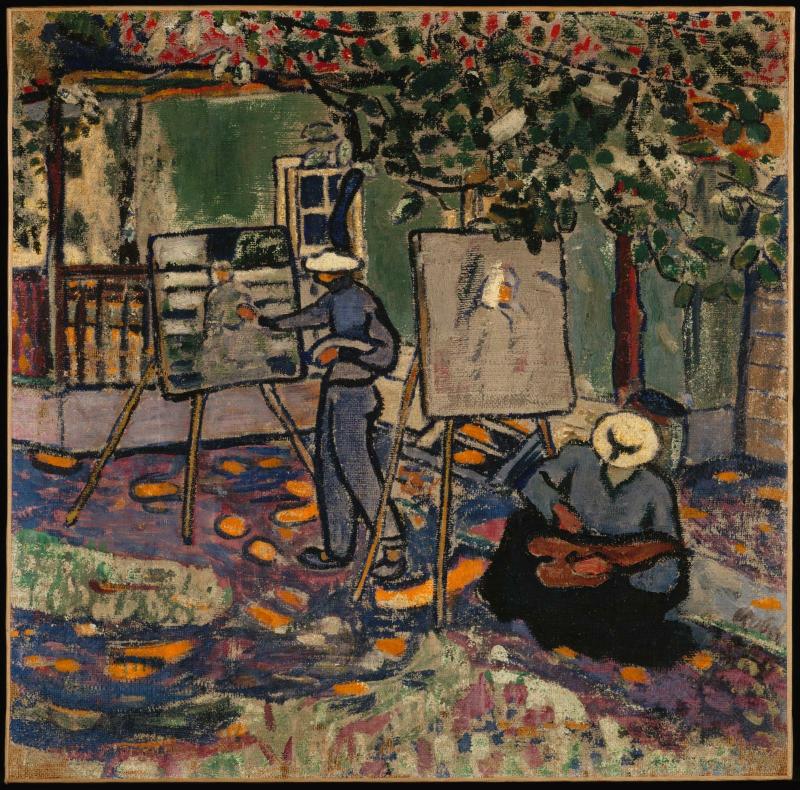
Béla Czóbel. Peintres à la campagne. 1906
Centre Pompidou, MNAM

Béla Czóbel. Peintres à la campagne

“Painters in the Country” · 1906 · Oil on canvas · Centre Pompidou

Czóbel was the only non-French artist in the Fauvist room at the 1906 Salon d'Automne, alongside Matisse, Derain and Dufy. Peintres à la campagne (in the salon catalogue as Deux Peintres, “Two Painters”) is almost a manifesto of the Fauvist community: two painters with easels in a garden, surrounded by layers of green and ochre laid down in broad strokes without half-tones. The subject is deliberately everyday — and that is part of the programme: Fauvism sees itself as plein-air painting, heir to the Impressionists — but sharper, flatter and more emotional. Through Czóbel, Fauvism almost immediately spread beyond France — to Hungary, then more widely across Central Europe. At the exhibition this painting answers the question: “who heard Matisse already in the first winter after Collioure?” — even those without a French passport heard him.

Neighbours in the gallery

Maurice de Vlaminck

1876—1958

The most radical “wild beast” among the Fauves — he squeezed paint straight from the tube, pushing colour to maximum intensity.

Albert Marquet

1875—1947

Matisse's fellow student under Gustave Moreau; beside him Fauvism becomes restrained, almost topographical — especially in harbour views.

Charles Camoin

1879—1965

Another pupil of Moreau; in Saint-Tropez and Collioure in 1905 he worked side by side with Matisse and Derain.

Georges Braque

1882—1963

A brief Fauvist period in 1906—1907 (L'Estaque, Antwerp) — a prologue to Cubism, which he would soon build with Picasso.

Kees van Dongen

1877—1968

A Dutchman in Paris; he takes the Fauvist palette and transfers it to portraiture — first café-concert, then high society.

Béla Czóbel

1883—1976

Hungarian artist; through him the Fauvist impulse quickly spread into Eastern Europe.

Sonia and Robert Delaunay

1885—1979 / 1885—1941

From the Fauvist palette they develop their own “Simultanism” — colour no longer as description but as an independent musical rhythm.

Biographical notes

Paul Signac

Paris, 1863 — Paris, 1935

Co-founder and chief theorist of Neo-Impressionism (after Seurat's death — the movement's leading figure). Author of the treatise D'Eugène Delacroix au néo-impressionnisme (1899), which set the framework for understanding “colour as method”. In 1904 he welcomed the young Matisse in Saint-Tropez — that summer proved decisive for the birth of Fauvism; Signac bought Matisse's study Luxe, calme et volupté.

André Derain

Chatou, 1880 — Garches, 1954

Matisse's closest comrade in the Fauvist year of 1905; they worked together in Collioure. Connected with Vlaminck (shared studio in Chatou), with Picasso, with dealers Vollard and Kahnweiler. After the 1910s he turned towards a “return to order” and the classical tradition — a trajectory that makes him an especially interesting figure in discussions of Matisse's legacy.

Maurice de Vlaminck

Paris, 1876 — Rueil-la-Gadelière, 1958

Self-taught, bicycle racer and violinist before he became a painter. Shared a studio with Derain; in 1905—1907 he pushed Fauvist colour to maximum intensity — pure cadmium, ultramarine, emerald. Later he sharply turned towards a dark palette and atmospheric landscapes in the spirit of Cézanne.

Gallery

Primitivisms, or Emotions

≈ 1905 — 1914

Matisse's path to modern art passed through an early encounter with art from beyond Europe. “Primitivism” for him was not exoticism but a way to find an alternative to the academic canon he considered exhausted. The flatness of Le Luxe I refers to frescoes in Tuscan churches he saw in the summer of 1907. And his sculptural experiments were fuelled by African sculpture — a contrasting play of volumes unknown to the European tradition.

Between 1905 and 1914 Matisse became increasingly well known abroad. Local avant-gardes received him in their own ways — each with its own “primitivist” turn. German Expressionists went their own path, separate from Fauvism, but shared with Matisse a belief that emotion lies at the heart of art. In the East, Matisse was collected by Sergei Shchukin and Ivan Morozov, and his paintings were shown alongside works by Natalia Goncharova and Mikhail Larionov — Russian avant-gardists most open to Parisian modernism.

I do not paint things literally — I paint the impression they make on me.
Henri Matisse

Key works

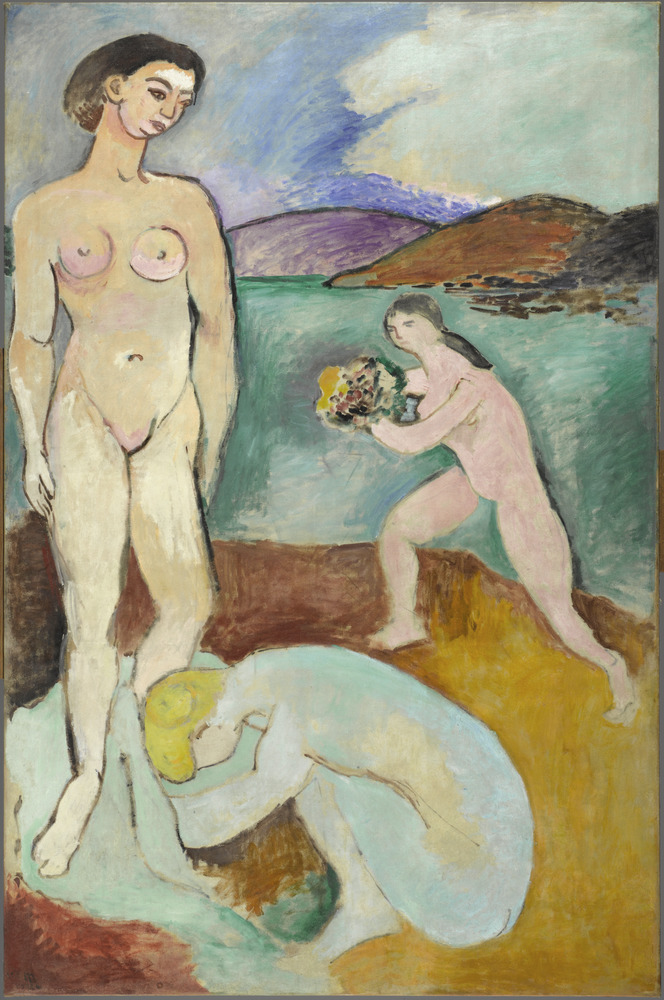
Henri Matisse. Le Luxe I. 1907
Centre Pompidou · Wikimedia Commons

Henri Matisse. Le Luxe (I)

“Luxury (I)” · 1907 · Oil on canvas · 210 × 138 cm · Centre Pompidou

After the pointillist Luxe, calme et volupté (1904) — a completely different tone. Matisse spent the summer of 1907 in Tuscany, where he saw frescoes by fifteenth-century Florentine masters, and brought back from there a different idea of a “golden age”. Pure flatness, clear contour, no volume — three nude figures on the shore look more like saints from medieval wall painting than classical bathers. The subject is ambiguous: preparation for bathing, a ritual scene, or simply an experiment — the same figure in three different poses. Large size, vertical format — this is no longer a “genre scene” but a monumental decorative painting. 1907 was a turning year: Matisse simultaneously turned away from descriptive Impressionism and from the Fauvist colour shock in favour of pure simplicity of form. This direction would remain his main one until the end of his life.

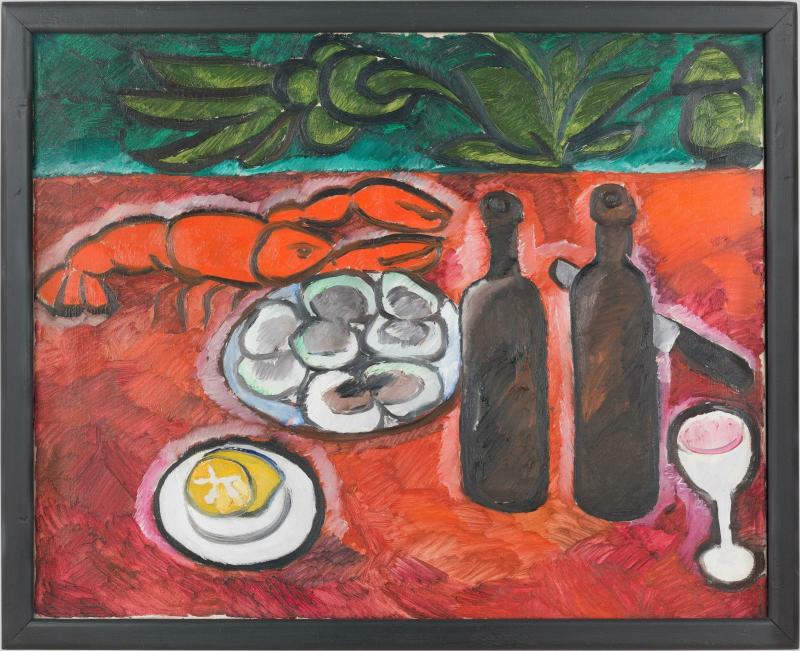
Natalia Goncharova. Nature morte au homard. 1909—1910
Centre Pompidou (gift Nina Kandinsky, 1981)

Natalia Goncharova. Nature morte au homard

“Still Life with Lobster” · 1909—1910 · Oil on canvas · 73 × 88.1 cm · Centre Pompidou

On a red tablecloth — a lobster, two dark bottles, a glass, a plate of oysters. A French tavern seen through the eyes of a Russian icon. No perspective, no modelling of light — space flattened almost to a poster, colour working at maximum. In Moscow in 1909 such a still life was a double slap: to academic tradition and to bland European Impressionism. Goncharova had seen Matisse in the Moscow collections of Sergei Shchukin and Ivan Morozov, loved folk lubok prints and icons — and together with Larionov invented from this Neo-Primitivism, a Russian answer to Western modernism. Not imitation but a parallel path. In Barcelona the work is placed beside Matisse to show: the primitivist turn happened simultaneously in Paris and Moscow, and the movement ran in opposite directions.

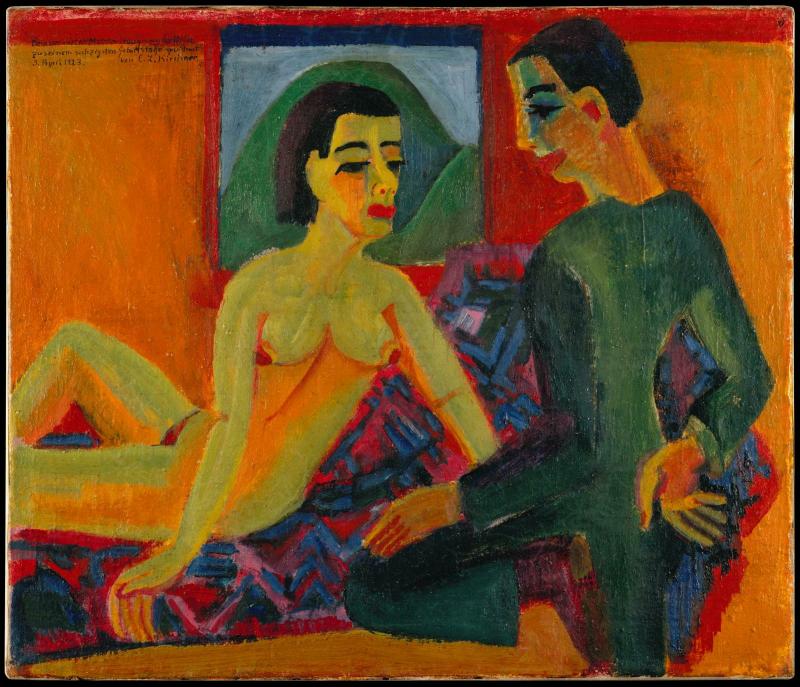
Ernst Ludwig Kirchner. Liebespaar. 1921—1923
Centre Pompidou

Ernst Ludwig Kirchner. Liebespaar

“Lovers” · 1921—1923 · Oil on canvas · Centre Pompidou

Kirchner — founder of the Dresden group Die Brücke (1905), the leading figure of the first wave of German Expressionism. The painting was made later, in Davos, where the artist moved in 1917 after a nervous breakdown from front-line experience. The subject — a nude model (probably dancer Nina Hard, who stayed with Kirchner in 1921) and a clothed man — is resolved Expressionistically: colour here does not describe but conveys the “temperature” of the relationship between the figures. Green shadows on bodies, ultramarine contours, sharp diagonals of the carpet — everything works on emotion. In dialogue with Matisse one thing matters: Expressionists took liberated colour from Fauvism but translated it into another language — not decorative but psychologically charged, closer to Van Gogh than to Cézanne.

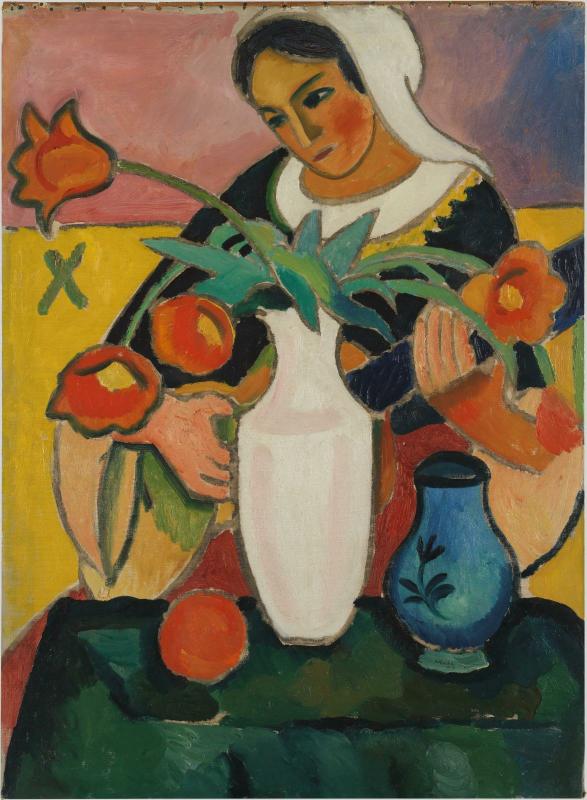
August Macke. Lautenspielerin. 1910
Centre Pompidou (gift Nina Kandinsky, 1966)

August Macke. Lautenspielerin

“Girl with a Lute” · 1910 · Oil on canvas · 91 × 66.5 cm · Centre Pompidou

August Macke — one of the founders of the Munich group Der Blaue Reiter (“The Blue Rider”, 1911), together with Kandinsky and Franz Marc. This painting was shown at the group's very first exhibition in 1911. It shows a girl in Bavarian folk costume playing a lute, with a white vase of orange flowers before her. Flat colour patches outlined in black — a device from Bavarian folk reverse-glass painting (Hinterglasmalerei), which Macke and Kandinsky were then seriously exploring. But the spatial structure and saturated colour are already visible influence from Matisse, whose works Macke could have seen at the major Sonderbund exhibition in Cologne. In Lautenspielerin two streams converge: German folk tradition and the Parisian avant-garde. This hybrid is the portrait of Der Blaue Reiter in its first year.

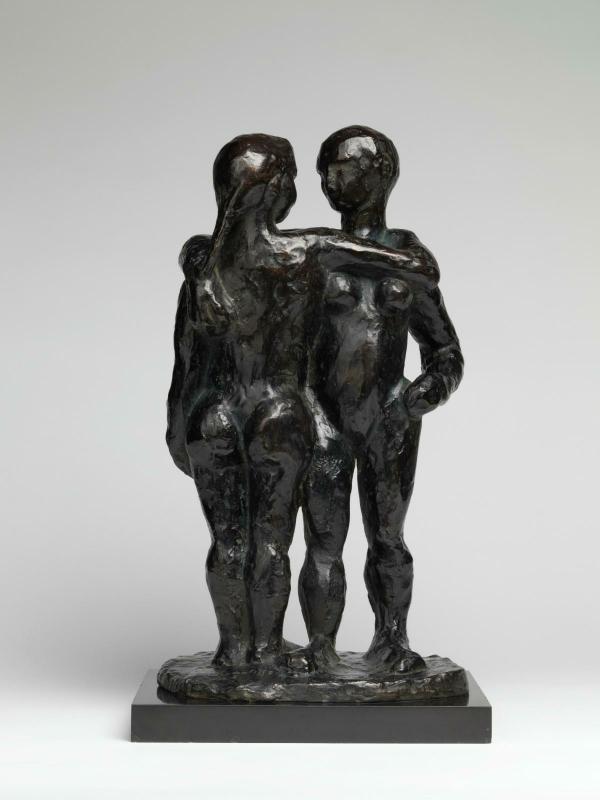
Henri Matisse. Deux négresses. 1907—1908
Centre Pompidou (gift Pierre Matisse, 1991) · cast 2/10, Fonderie Valsuani, 1952

Henri Matisse. Deux négresses

“Two Negresses” · 1907—1908 (cast 1952) · Bronze with dark patina, black marble base · 49.5 × 28 × 20 cm · Centre Pompidou

A direct primitivist gesture by Matisse in sculpture. By his own account, the impulse was a photograph of African women seen in a magazine. The composition — two nude figures in a tight embrace — refers simultaneously to African sculpture (compact undivided mass, low-set hips) and to antique “Three Graces”, only without any classical grace. Bronze here works like clay: the surface deliberately rough, the sculptor does not “finish” but leaves traces of fingers and tools. In Barcelona — cast 2/10 from 1952 by the Valsuani workshop, given to the Centre Pompidou by Pierre Matisse in 1991. Beside Le Luxe I from the same year of 1907 you see one thing: the idea of a flat figure in painting and the idea of compressed, compact volume in sculpture — the same solution unfolded in two materials.

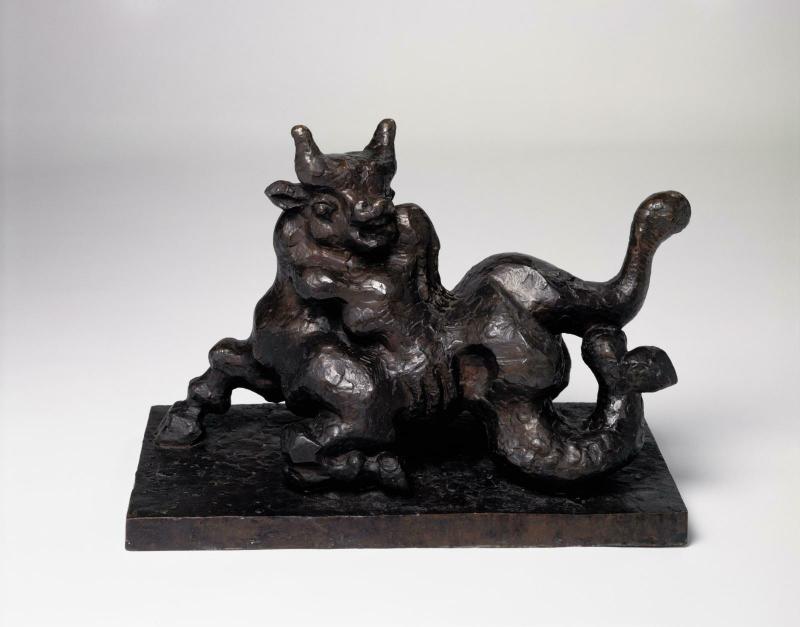
Jacques Lipchitz. L'Enlèvement d'Europe. 1938
Centre Pompidou (state acquisition, 1947)

Jacques Lipchitz. L'Enlèvement d'Europe

“The Rape of Europa” · 1938 · Bronze · 39 × 67 × 32 cm · Centre Pompidou

Jacques Lipchitz — a Lithuanian from Druskininkai, a Paris Cubist of the 1910s, then one of the main modernist sculptors of the interwar period. The mythological subject (Zeus as a bull carrying the Phoenician princess Europa to Crete) is resolved through dense, flowing, almost Baroque mass — without clear separation of “bull” and “figure”: one fused body where it is no longer clear where one ends and the other begins. Pompidou curators place this work beside Matisse's Deux négresses not as stylistic rhyme but as continuation of one line: interest in compact, whole volume, which in Matisse was born in the 1900s and in Lipchitz continues in dramatic mythological subjects of the late 1930s. Lipchitz himself said he was inspired by Coptic bronze from his collection — that is, like Matisse thirty years earlier, he turned to art beyond Europe in search of another grammar of form. The link here is not stylistic but structural: twentieth-century modernist sculpture in both cases is born from refusal of anatomical detail in favour of tangible volume.

Neighbours in the gallery

Emil Nolde

1867—1956

Northern German, one of the leaders of Die Brücke in its first season; at the exhibition — still life Stilleben mit zwei Tänzerinnen (1914) with a marketing statuette of dancers.

Max Pechstein

1881—1955

Also from Die Brücke; in the work shown, In den Dünen (1911) — nudes on dunes in the spirit of the same “golden age” Matisse was pursuing.

Sonia Delaunay

1885—1979

Early work Philomène (1907): portrait with dark background in large patches — between Fauvist colour and Expressionist emotional density.

Erich Heckel

1883—1970

Co-founder of Die Brücke with Kirchner, Schmidt-Rottluff and Bleyl; woodcut as a method of “returning to the primary”.

Franz Marc

1880—1916

Co-founder of Der Blaue Reiter; colour symbolism and animal imagery as a search for pre-human purity.

Wassily Kandinsky

1866—1944

Leader of Der Blaue Reiter; from Bavarian reverse-glass painting to the first abstraction of the 1910s. His widow Nina gave much of what hangs in this gallery to Pompidou.

Biographical notes

Natalia Goncharova

Nagaevo, 1881 — Paris, 1962

Key figure of the Russian avant-garde; together with Larionov (her lifelong partner) she formulated the concept of Neo-Primitivism, drawing on lubok prints, icons and Scythian sculpture. Before moving to Paris in 1915 she had worked with Stravinsky and Diaghilev (costumes and sets for ballet). In her still lifes of the late 1900s you see direct influence from Matisse, but recast in her own language — massive, Scythian, not Parisian.

Mikhail Larionov

Tiraspol, 1881 — Fontenay-aux-Roses, 1964

Goncharova's companion and ideologue of the Moscow avant-garde of 1908—1914. Author of the manifesto “Rayonism” (1913) — one of the early abstract programmes. In this gallery — still life Nature morte aux soucis et plante grasse (c. 1908—1909), where Cézanne's constructive approach intersects with Matisse's local colour. After moving to Paris in 1915 he worked, like Goncharova, with Diaghilev's company.

Ernst Ludwig Kirchner

Aschaffenburg, 1880 — Davos, 1938

Co-founder of the group Die Brücke (Dresden, 1905) — the programmatic union of German Expressionism. After traumatic First World War experience he lived in Davos, where he painted most of his late works. In 1937 his works appeared in the Nazi exhibition Entartete Kunst (“Degenerate Art”); a year later — suicide.

August Macke

Meschede, 1887 — Champagne, 1914

One of the founders of the Munich group Der Blaue Reiter (1911) together with Kandinsky and Marc. The trip to Tunisia in 1914 with Paul Klee and Louis Moilliet — a legendary episode of modernism: in two weeks a language was born combining pure colour, flatness and geometry. A few months later Macke was killed at the front — aged 27.

Emil Nolde

Nolde, 1867 — Seebüll, 1956

The oldest in Die Brücke; joined the group in 1906 and left a year later. Main motif — colour as pure emotional force, especially in religious compositions and North Sea landscapes. A complex figure: sympathised with the Nazis but was declared a “degenerate” artist by them in 1937; this paradox makes him one of the central figures in discussions of art and politics in the twentieth century.

Gallery

Conjuring Apparitions

1914 — 1917

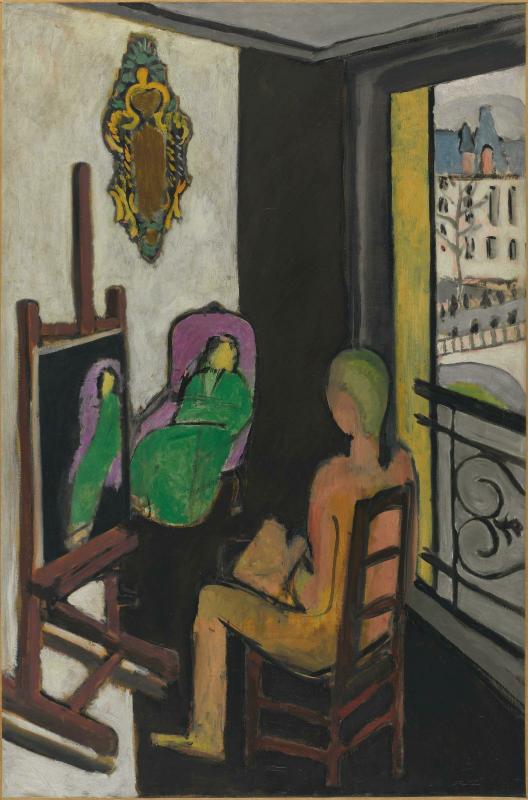
The First World War overturned Matisse's world. His attempt to enlist as a volunteer at 45 was rejected. The artist divided his time between the studio on the quai Saint-Michel in Paris and his home in Issy-les-Moulineaux. In works such as Intérieur, bocal de poissons rouges and Le Peintre dans son atelier he returns to intimate space, uses the window motif and a more inward gaze (his own place beside the model) — and achieves a spatial ambiguity unlike any of his contemporaries.

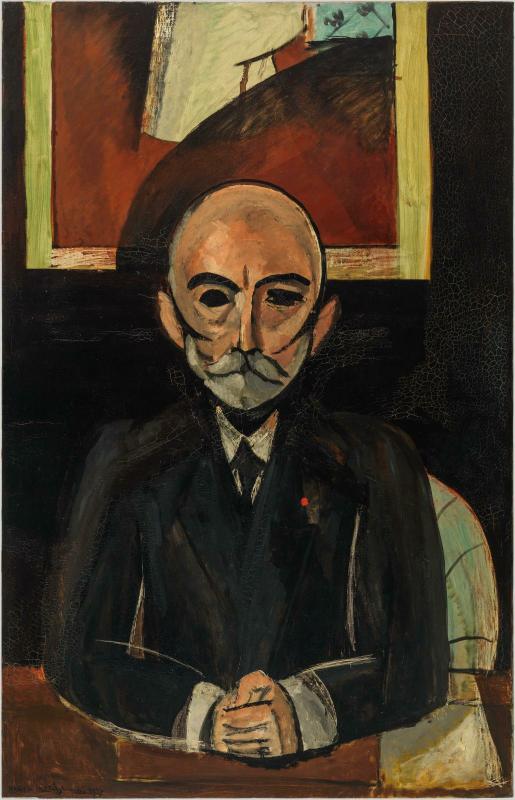
Matisse's wartime portraits become a field of radical experiment. During sessions he tries to catch the invisible flow of energy between himself and the model. In portraits of actress Greta Prozor (1916) and collector Auguste Pellerin (1917) the figure on the canvas is surrounded by an almost ghostly radiance.

I felt I owed it to the country, to the children, to my own conscience — to keep on painting.
Henri Matisse, letter to Charles Camoin, 1914

Key works

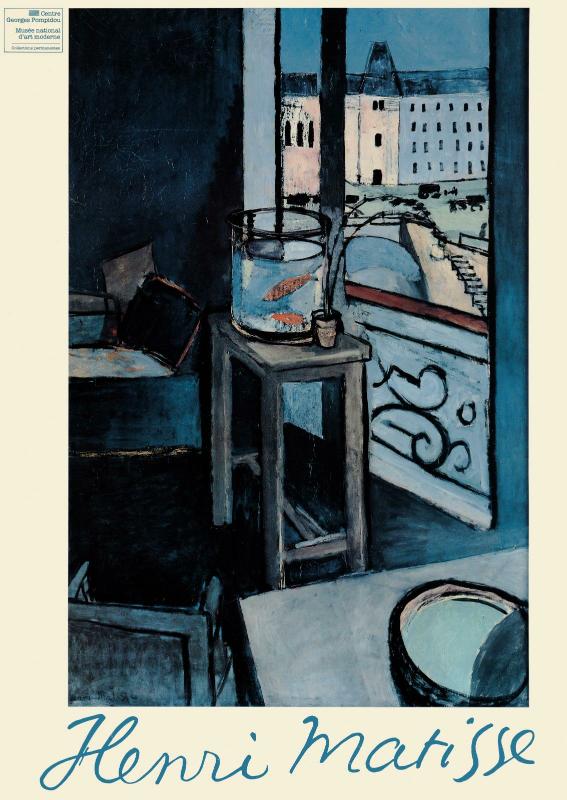
Henri Matisse. Intérieur, bocal de poissons rouges. 1914
Centre Pompidou (bequest of Baron Gourgaud, 1965)

Henri Matisse. Intérieur, bocal de poissons rouges

“Interior with Goldfish Bowl” · 1914 · Oil on canvas · 147 × 97 cm · Centre Pompidou

In 1914 Matisse lived on the fourth floor of no. 19 quai Saint-Michel — one floor below his former studio of 1892—1908. The painting shows the interior of the new studio: a tall French window with a view of the Seine and the Île de la Cité, before it a bowl with two goldfish on a stool. The curved line of the bowl rhymes with the arches of the Pont Saint-Michel outside the window — a typical Matisse play of forms between interior and exterior view. The palette — deep blue-greys, graphite, ochre against an almost black room — differs sharply from the southern Fauvist celebration of a decade earlier. This is the first of four works in which Matisse begins moving towards abstraction: reality is still recognisable, but planes already diverge, colour stops describing and starts existing on its own. Originally the painting was intended for Sergei Shchukin's collection in Moscow, but the war prevented it. In the 1920s Baron Gourgaud bought it and bequeathed it to the museum in 1965.

Henri Matisse. Le Peintre dans son atelier. 1916—1917
Centre Pompidou (acquisition 1945)

Henri Matisse. Le Peintre dans son atelier

“The Painter in His Studio” · 1916—1917 · Oil on canvas · 146.5 × 97 cm · Centre Pompidou

The painting shows the artist himself seated at an easel in the same studio on the quai Saint-Michel — but this is not a classical self-portrait. The face is hidden, the figure treated in sharply generalised form, the orange tone of the body deliberately “unrealistic”, and on the easel another work in progress is visible — “Lorette in a Green Dress” (1916). Before the easel — a model in pink and green; to the right an open window with a view of Paris rooftops and the silhouette of Notre-Dame. The result is a triple composition: artist + model + painting in progress, each layer separated from the others by dense black planes. This is Matisse's reflection on his own work during the war — an attempt to formulate what it means to paint when the world is collapsing around you. The dark, almost mourning palette and direct geometric divisions of space — a laboratory from which Matisse's most radical abstraction experiments would emerge a year later (see Gallery IV).

Henri Matisse. Auguste Pellerin II. 1917
Centre Pompidou (acquisition 1982)

Henri Matisse. Auguste Pellerin II

“Auguste Pellerin II” · 1917 · Oil on canvas · 150.2 × 96.2 cm · Centre Pompidou

Auguste Pellerin — industrial magnate, owner of up to eighty Cézanne canvases. He commissioned his portrait from Matisse in 1916; the result of the first version did not satisfy him, and Matisse painted a second — this version was accepted and dated May 1917. The face is assembled with extreme economy: an oval, two dark patches instead of eye sockets, white “wings” of moustache — a flat ornamental sign. The background is black, cut through by a complexly coloured fragment of a “painting within a painting” (apparently one of Pellerin's own Cézannes). The pose is formal, the suit respectable, but the whole structure of the portrait is anti-portrait: instead of a flattering heroic image of a businessman Matisse offers an almost ritual mask, a ghostly “apparition” of industrial capitalism. According to Pellerin, Matisse initially offered to leave both versions for the price of one — the client refused and bought both.

Neighbours in the gallery

Henri Matisse. Le Violoniste à la fenêtre

1917—1918

A figure in a yellow robe with a violin, back to the viewer — continuation of the same window motif, but already on the threshold of the southern lightness of the next gallery.

Kees van Dongen. Autoportret

1895

An early Fauvist self-portrait a decade before Fauvism: dark silhouette at a window with instruments — a motif Matisse would develop in his own work a quarter-century later.

Greta Prozor, portrait

Matisse, 1916

Lithuanian-French actress (symbolist theatre of Paul Fort, Ibsen productions) — the model in whose 1916 portrait Matisse first applied the “ghostly aura”.

Biographical notes

Auguste Pellerin

Saint-Chamond, 1852 — Neuilly, 1929

Industrial magnate — founder of the “Société des Margarines”, known as “Astra”. One of the greatest Cézanne collectors in history: by the end of his life his collection held about 90 works by the artist, including central landscapes of Gardanne and views of Lac d'Annecy. Commissioning his portrait from Matisse, Pellerin saw in him heir to the Cézanne line — hence the choice of this artist rather than a more “glossy” salon portraitist. His collection later dispersed to the world's major museums.

Lorette (Laurette)

dates unknown

Matisse's main model of 1916—1917; an Italian woman with whom the artist painted a series of at least fifty works in one year. In Le Peintre dans son atelier we see her twice: once in the reality of the room, a second time as her own portrait on the easel. For Matisse in wartime Lorette was simultaneously body, form and pretext: a reason to return to intimate scale when the world around became unbearable.

Gallery

Increasing Abstraction

1914 — 1917

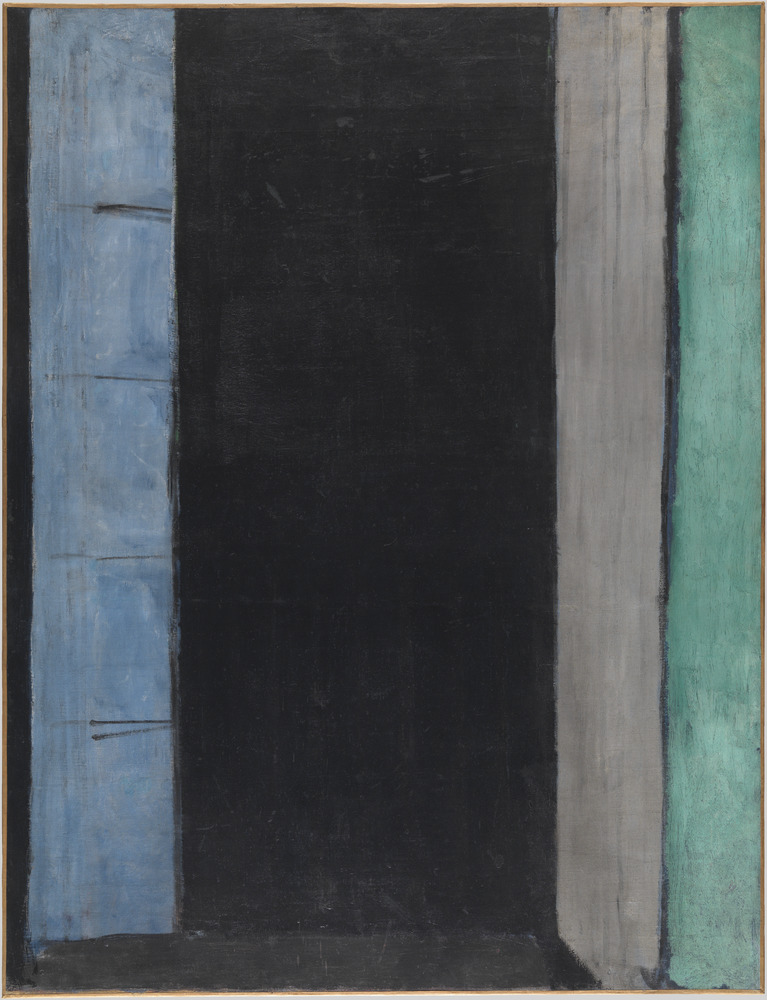
Matisse witnessed the birth of Cubism as early as 1908 and hosted members of the Paris avant-garde who remained in the capital during the war at his home in Collioure. In August 1914 he went there himself and painted only one canvas all summer — Porte-fenêtre à Collioure. The black rectangle at its centre gathers and holds the whole composition; beneath it remains an almost erased underpainting with an open view of the balcony. This work, which Matisse kept until the end of his life and never showed publicly, became his first step towards “black light”.

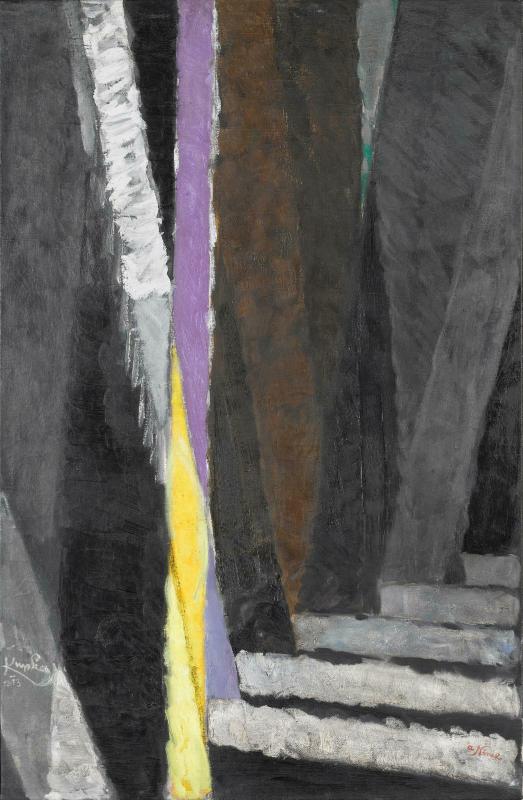
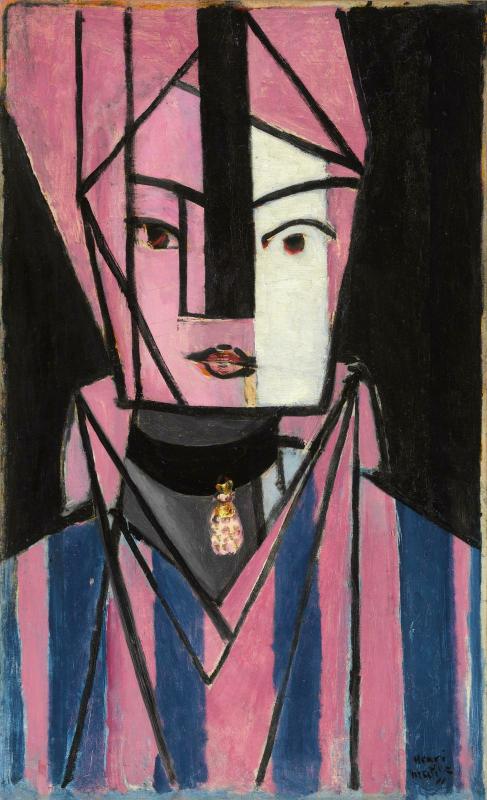
A similar search for lines of force and planes of colour sounds in the work of František Kupka — his Plans verticaux series breaks form into coloured planes arranged like vertical stripes. This is already almost abstraction and at the same time recalls the Cubist grid. Matisse's work Tête blanche et rose — a portrait of his daughter Marguerite — plays with the same square grid but keeps a recognisable subject and therefore fits no ready-made style.

There is light in black.
Henri Matisse, 1946

Key works

Henri Matisse. Porte-fenêtre à Collioure. 1914
Centre Pompidou · Wikimedia Commons

Henri Matisse. Porte-fenêtre à Collioure

“French Window at Collioure” · September—October 1914 · Oil on canvas · 116.5 × 89 cm · Centre Pompidou

Summer and autumn 1914 Matisse spent in Collioure — where he returned nine years after the Fauvist summer of 1905, this time to escape Paris wartime mobilisation. The painting shows the French window of his room — but almost nothing “shown” in it remains. Three vertical stripes — grey, ochre, green-turquoise — frame a central almost-black rectangle that replaces what should open beyond the door: landscape, sky, sea. This is the famous “black light” — a paradoxical effect in which the darkest plane works as radiating. The painting remained in Matisse's studio until his death; he considered it his own “closed window” and never showed it publicly. In radicality of refusal of the motif this is Matisse's most abstract canvas of his entire career; a year later he would step back and return to the figure, but this work would remain in his archive as the “extreme point” he marked for himself.

František Kupka. Plans verticaux. 1912—1913
Centre Pompidou

František Kupka. Plans verticaux

“Vertical Planes” · 1912—1913 · Oil on canvas · Centre Pompidou

Czech artist František Kupka moved to Paris in 1896; from 1909 verticality began to occupy him as a way to convey movement and introduce a “fourth dimension” — time — into painting. By 1912 vertical planes became an independent motif, detached from any descriptive task. This work is part of a series of several canvases in which Kupka varies one composition: black, grey, ochre, purple verticals with bright accents of yellow and pink. Pompidou curators call such canvases “ancestors of compositions by Malevich, Arp and Mondrian” — among the first pure geometric abstractions in the history of European modernism. In dialogue with Matisse this is an important counterpoint: Kupka in 1912—1913 does what Matisse approaches in 1914 but in the end does not do — refuses to cross the threshold of abstraction to the end.

Henri Matisse. Tête blanche et rose. 1914—1915
Centre Pompidou (acquisition 1976)

Henri Matisse. Tête blanche et rose

“White and Pink Head” · 1914—1915 · Oil on canvas · Centre Pompidou

Another portrait of daughter Marguerite (cf. Marguerite au chat noir of 1910 from the intro) — but now, four years later, in a completely different register. The face is broken into sharp geometric segments: black lines cut through pink flesh, the white half of the face contrasts with the pink, the mouth treated as an independent plastic motif. This is a visible response to Cubism — to Picasso and Braque, whose works Matisse examined with interest from 1908—1909. According to family tradition, Matisse asked his daughter whether she agreed for him to “take her somewhere else” — she agreed, and the artist reworked in the new spirit an already begun canvas Jeune femme au chapeau corbeille of 1914. The painting remained in Matisse's studio all his life and entered MNAM only in 1976. Today it is considered one of Matisse's main portraits and simultaneously the point of maximum convergence between Matisse and Cubist geometry.

Neighbours in the gallery

František Kupka. Plans verticaux I

1912

An earlier version of the series: turquoise background, on it several rectangles of different sizes and shades. The first Kupka work acquired by the French state.

Henri Matisse. Portrait de Greta Prozor

≈ 1916

Portrait of an actress in a long blue dress on a yellow ground — a transitional object between the “ghostly aura” of Gallery III and the geometric abstraction of Gallery IV.

Georges Braque

1882—1963

A former Fauve, by 1914 already author of Analytical Cubism; it is his grid of spatial planes and black contours that is the main reference for Tête blanche et rose.

Biographical notes

František Kupka

Opocno, 1871 — Puteaux, 1957

Czech artist who moved to Paris in 1896 and lived his whole life in France. One of the first four European artists (together with Kandinsky, Malevich and Mondrian) to arrive at pure abstraction — and among the earliest: already by 1911—1912. Connected with the Section d'Or group (Puteaux group: Duchamp, Gleizes, Metzinger, Léger). In 1936 his first major retrospective took place at the Prague Mánes Society.

Marguerite Matisse

Bohain-en-Vermandois, 1894 — Paris, 1982

The artist's elder daughter from his first partner, model Camille Joblaud; she was adopted and raised by Amélie Matisse. From childhood — her father's main model (more than 30 portraits). At 6 she underwent a tracheotomy (throat surgery) — hence the characteristic high collars in many of her portraits, hiding the scar. During the Second World War she took part in the Resistance, was arrested by the Gestapo, survived. After her father's death she became keeper of his archive and curator of his legacy; she organised key posthumous exhibitions.

Gallery

Our Heart Looks South

1917 — 1929

At the end of 1917 Matisse moved to Nice — on the French Riviera. The following period led him away from the experimental direction of his early work towards interior scenes in which a renewed female model posed anew, in fresh angles, the question of how to place the figure in space (visible in Figure décorative sur fond ornemental). The props and poses of his compositions carry echoes of his travels through the Maghreb and Spain.

Former Fauves such as Albert Marquet and Kees van Dongen had by this time also reworked their visual language — under the influence of Mediterranean light (Spain, Algeria, Egypt). For Natalia Goncharova, who discovered Spain in 1916, the archetype of the woman in a mantilla became the basis for an inquiry in which hieratic form and decorative elements — echoes of the icon — resonate with Matisse's own artistic reflections.

I do not separate feeling and work. I do not separate the person I am from the artist.
Henri Matisse, Nice years

Key works

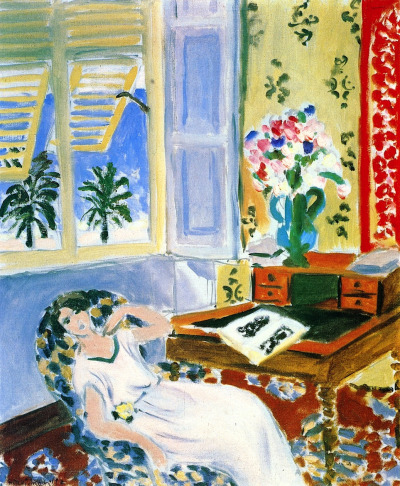
Henri Matisse. Intérieur à Nice, la sieste. 1922
Centre Pompidou (bequest of Frédéric Lung, 1961)

Henri Matisse. Intérieur à Nice, la sieste

“Interior at Nice, Siesta” · January 1922 · Oil on canvas · 66 × 54.5 cm · Centre Pompidou

At the end of 1917 Matisse moved to Nice — first to the Hôtel Beau-Rivage, then to his own flat on the third floor of Place Charles-Félix. From this moment until the late 1920s the main theme of his painting is the interior with open shutters and landscape beyond the window. Siesta shows a female figure (probably Henriette Darricarrère, Matisse's main model of the 1920s) lying on a red sofa in a floral dress; behind her — a window with a view of the palm trees of the Promenade des Anglais. This is Matisse's “lightest” phase: after wartime gloom and Cubist geometry of 1914—1917 — a return to decorativeness, ornament, warm light. The painting passed through several collections (among others Frédéric Lung, an Alsatian merchant settled in Algeria) and entered the French national museums in 1961. Modest size — this is no longer the monumental decoration of Gallery I but an intimate, almost everyday format.

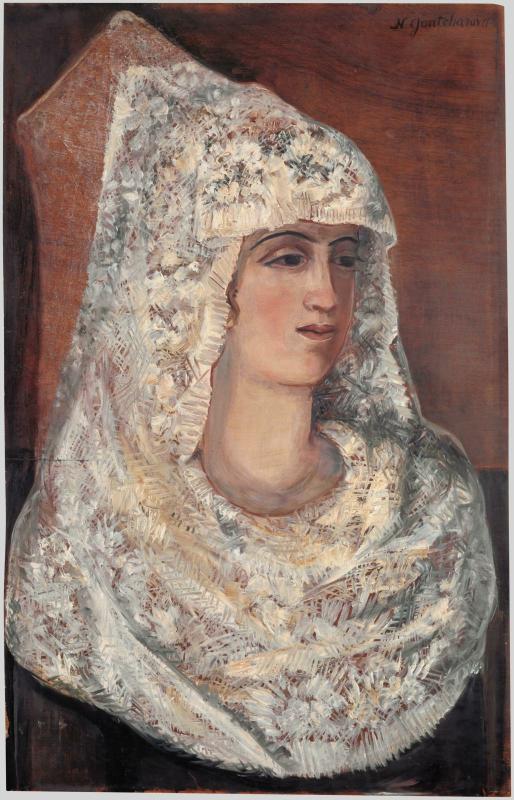
Natalia Goncharova. Espagnole. 1920—1930
Centre Pompidou

Natalia Goncharova. Espagnole

“Spanish Woman” · 1920—1930 · Oil on canvas · Centre Pompidou

Goncharova discovered Spain in the summer of 1916: from July to September she lived in San Sebastián and travelled through the country with Diaghilev's company. From this trip began her long series of “Spanish women” — dozens of portraits of women in mantillas, lace shawls, traditional dress. This work is a characteristic example of what critics called femme-cathédrale, “woman-cathedral”: the figure elongated to Gothic verticality, the face simplified to an immobile mask, the lace mantilla working almost like a Gothic stained-glass window. In Gallery V Goncharova's southern theme is placed beside Nice-period Matisse: both artists after the catastrophe of the First World War seek support in the traditional, warm, feminine, Mediterranean. But Goncharova goes from the Russian icon to frozen vertical severity, while Matisse goes from planar geometry to decorative abundance.

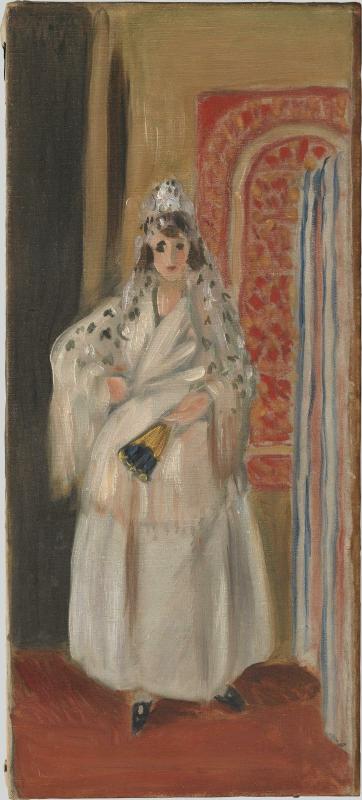
Henri Matisse. Jeune Espagnole. 1921
Centre Pompidou, deposit at Musée des Beaux-Arts de Bordeaux

Henri Matisse. Jeune Espagnole

“Young Spanish Woman” · 1921 · Oil on canvas · Centre Pompidou (deposit, Bordeaux)

Matisse spent several weeks in Seville and Granada in the winter of 1910—1911; the impression of Spain stayed with him for years — hence the series of “Spanish women” to which this work belongs. A young woman in traditional Spanish dress with a fan stands in a richly decorative interior: red Persian carpet, patterned wallpaper, gilded furniture. The composition is almost ritual: frontal figure, clear contour, ornament covering the whole plane without pause. Beside Goncharova's Espagnole this is the same theme but a different strategy: Goncharova goes from the Russian icon and frozen severity, Matisse from decorative abundance and saturated flatness. The painting has been on permanent deposit at the Musée des Beaux-Arts de Bordeaux since 1961; it came to Barcelona from there.

Neighbours in the gallery

Henri Matisse. Lorette à la tasse de café

≈ 1917

Transitional work: Lorette (the wartime model) already on the Nice background of light grass — a bridge between Gallery III and Gallery V.

Kees van Dongen. Gitane

≈ 1910s

“Gypsy Woman” — a figure in a black shawl on a red-ochre ground; southern theme handled by a Fauve who had become a fashionable society portraitist.

Kees van Dongen. Anna-Marie Guérin

≈ 1910s

A girl in a white dress against a pink-grey wall — a child portrait in the style that made van Dongen a favourite of Parisian society commissions in the 1920s.

Biographical notes

Kees van Dongen

Delfshaven, 1877 — Monte Carlo, 1968

Dutchman who moved to Paris in 1899; early Fauve, friend of Picasso and neighbour at the Bateau-Lavoir. By the end of the 1900s already an independent figure with Fauvist portraits of society ladies and café-concert singers. After the First World War he became the most fashionable portraitist of Parisian high society — Anna de Noailles, Maurice Chevalier, marchionesses and countesses. He lived to 91 in Monte Carlo — the symbolic trajectory of “Fauve in a dinner jacket”.

Henriette Darricarrère

Nice, 1901 — Paris, 1972

Matisse's main model from 1920 to 1927; younger sister of Emilienne Darricarrère, who also posed for the artist. Ballerina and minor actress; in the mornings she danced at the Nice Opera, in the afternoons came to Matisse's studio. Through her figure Matisse built his entire “Nice period” — dozens of odalisques, interiors, portraits. After marrying in 1927 she stopped posing.

Gallery

Classical Modernities

Matisse in dialogue with Bonnard, Gilot and Picasso · 1930 — 1938

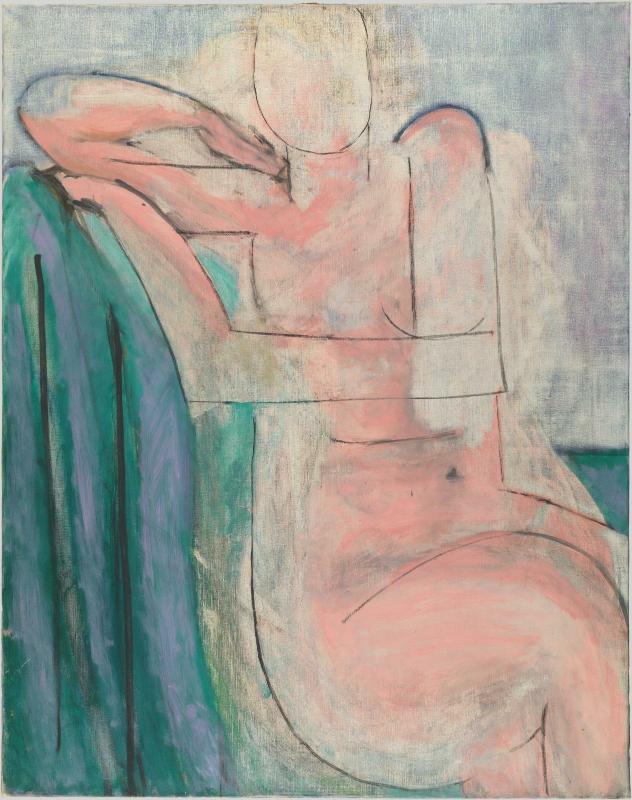
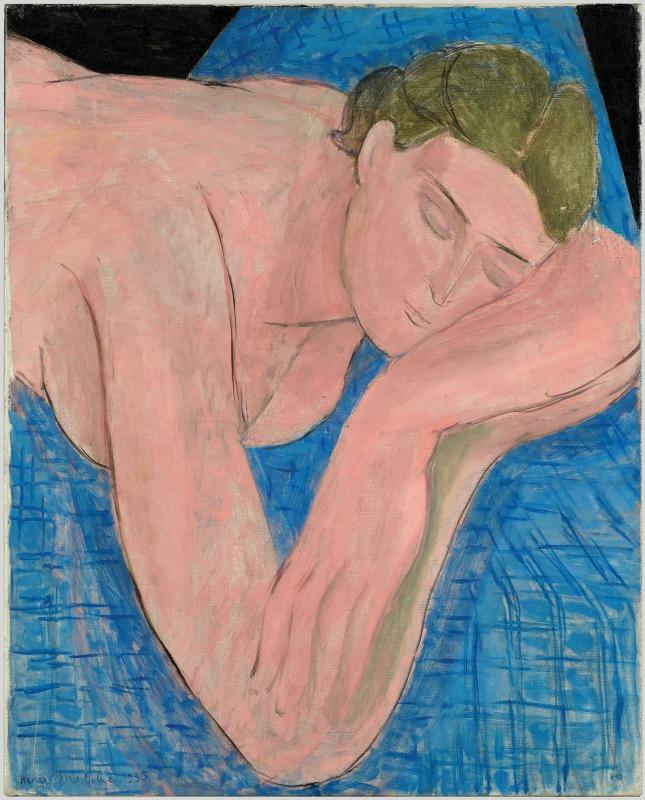
The 1930s brought Matisse a new sense of purpose. Trips to the USA and Oceania gave fresh impetus. In 1930 he received a commission for a large wall panel for Dr Albert Barnes's foundation in Pennsylvania. In La Danse Matisse projected his sharply simplified drawing into architectural space and for the first time used a cut-paper figure to build the composition. Work continued in Nice — with the help of his assistant and constant collaborator Lydia Delectorskaya, who in these years also became his favourite model; she is the heroine of Le Rêve and Nu rose assis.

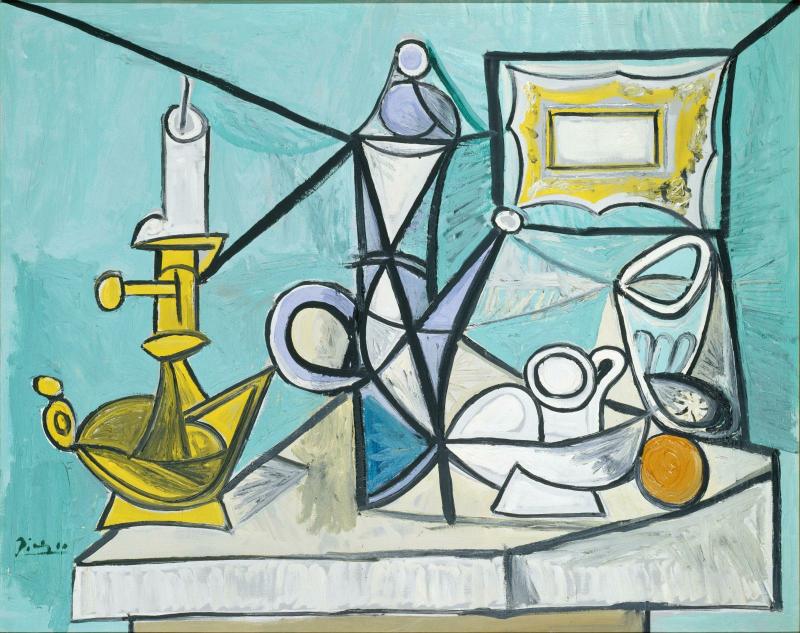
Picasso — Matisse's friend and rival since their first meeting at Stein's in 1906 — went his own parallel path in these years (his Nature morte au bougeoir is here beside him). The young artist Françoise Gilot, who in 1946 became Picasso's partner, in Évier et tomates approaches the still life with the same attentiveness with which Matisse treated objects.

When I speak of cutting directly into colour, I think of a sculptor's work in stone.
Henri Matisse, on work on La Danse

Key works

Henri Matisse. Nu rose assis. 1935—1936
Centre Pompidou

Henri Matisse. Nu rose assis

“Seated Pink Nude” (also Le Torse à la couronne) · 1935—1936 · Oil on canvas · Centre Pompidou

One of the first works for which Lydia Delectorskaya posed — a Russian émigrée who became Matisse's assistant in 1934 and his main model from 1935 to 1939. After the dense decorative Matisse of the 1920s here is a sharp turn to graphic simplicity: contour almost pencil-like, volume removed, the pink body dissolving smoothly into the striped fabric of the armchair. During the work Matisse photographed each stage — up to 22 images survive. From them you see how he gradually moved the figure closer to the viewer and cropped the frame tighter until there was literally “too much of her for the canvas”. This is already a new phase: Matisse stops describing the model and begins compressing her to a sign. A device that ten years later would lead him to cut-paper gouaches.

Henri Matisse. Le Rêve. 1935
Centre Pompidou

Henri Matisse. Le Rêve

“The Dream” · 1 April — 14 May 1935 · Oil on canvas · Centre Pompidou

Painted in parallel with Nu rose assis and shares with it the same model (Lydia Delectorskaya) and the same blue checked sofa cover. The figure lies with eyes closed, head on a bent arm, body compressed to a dense fused mass — almost the pose of a sleeping infant. Matisse brought the painting to this state through a series of intermediate stages traceable today in archive photographs: he gradually enlarged the face until the “serene expression” spread across almost the whole canvas. Blue-pink palette, refusal of modelling, pure contour — this is already almost an iconographic sign: the body as symbol of rest. According to Delectorskaya's memoirs, Matisse worked on the painting several hours a day, not letting it dry between sessions, and finished on the day of his sixty-sixth birthday.

Pablo Picasso. Nature morte au bougeoir. 1944
Centre Pompidou (bequest of M. Savary, 1969)

Pablo Picasso. Nature morte au bougeoir

“Still Life with Candlestick” · 8 April 1944 · Oil on canvas · 73 × 92 cm · Centre Pompidou

Wartime Paris, occupation nearing its end, four months before liberation. In these years Picasso shut himself in his studio on rue des Grands-Augustins and painted a series of harsh still lifes in which everyday objects (candle, coffee pot, saucepan, fruit) become almost symbolic signs of the time. Turquoise ground, clear black grid of contours, flat colour fields — still Cubist language, but already softened and emotionally charged. On the wall behind — an empty yellow frame with a white rectangle: a Picasso reference to conversation with Matisse, for whom the “painting within a painting” from the same year became a recurring motif. Placed in one gallery with Matisse's works of 1935, it shows: two rivals, having passed through the war, find themselves again in the same direction — where painting reclaims the right to be slow, quiet, contemplative.

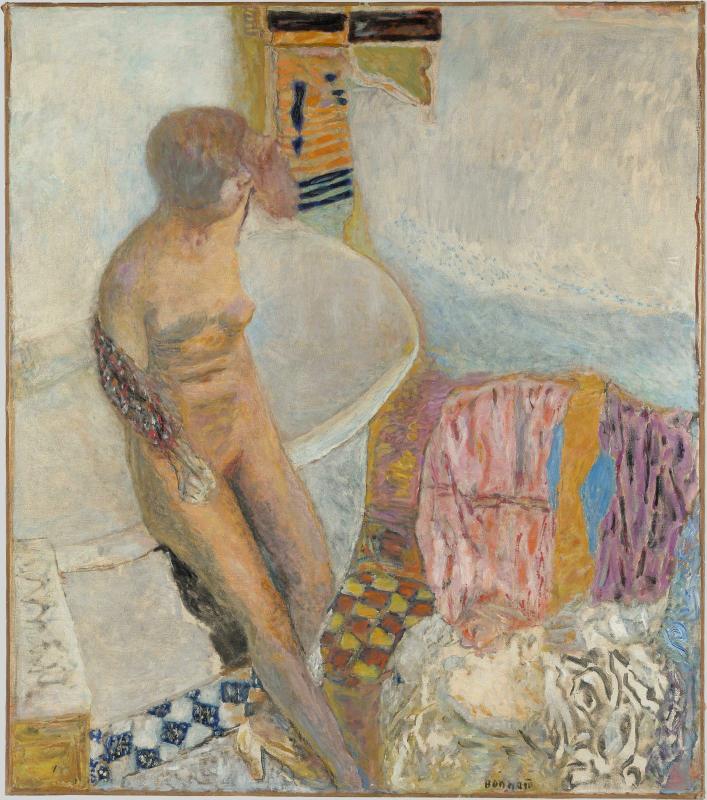
Pierre Bonnard. Nu à la baignoire. 1931
Centre Pompidou

Pierre Bonnard. Nu à la baignoire

“Nude by the Bathtub” · 1931 · Oil on canvas · 120 × 110 cm · Centre Pompidou

Bonnard painted this canvas at his villa Le Bosquet in Le Cannet on the Côte d'Azur; the model was his lifelong companion Marthe de Méligny. The composition is almost cinematic: view from above, figure cut by the edge of the canvas, bathroom tiles, rug, clothes on a chair, shutters — everything enters the frame like a photographic record. Bonnard's colour “vibration” — small strokes of warm and cool tones not mixing on the canvas — creates the effect that light in this room hangs in the air like a dense humid cloud. In the “Classical modernities” gallery Bonnard stands as parallel to Nice-period Matisse: the same southern light, the same domestic theme, the same refusal of avant-garde noise, but with a far warmer, Cézanne-like gaze. The friends corresponded until Bonnard's death (1947) — and for Matisse Bonnard was the “only one” worth having a conversation about painting with.

Neighbours in the gallery

Pierre Bonnard. Nu de dos à la toilette

≈ 1934

Pair to Nu à la baignoire: the same model in the same room, but at the dressing table, in yellow-orange palette — almost halogen temperature of southern midday.

Henri Matisse. Nature morte au buffet vert

1928

Still life with green sideboard, bowl of oranges and jug — a link between domestic Nice-period Matisse of the 1920s and the more graphic works of the 1930s.

Françoise Gilot. Évier et tomates

≈ 1946

“Sink and Tomatoes”: still life by a young artist, by then already Picasso's partner — her attention to objects as independent heroes empathically returns to Matisse's programme.

Biographical notes

Lydia Delectorskaya

Tomsk, 1910 — Paris, 1998

Russian émigrée from Siberia. In 1932 she came to the Matisses to help his wife Amélie with household and archive work. In 1934—1935 Henri asked her to pose — and from that moment she became his main model for the next five years (he painted her hundreds of times). After Amélie left home in 1939, Lydia effectively became mistress of Matisse's household, his assistant and keeper of the archive. Until the end of her life she preserved correspondence and works that in the 1950s—80s she gradually gave to Soviet (Hermitage, Pushkin Museum) and French museums. Without her the corpus of late Matisse would not have survived in its present form.

Pierre Bonnard

Fontenay-aux-Roses, 1867 — Le Cannet, 1947

One of the founders of the group Les Nabis (1890s), close to Vuillard and Denis; after the group dissolved he went his own way, keeping clear of Cubism and Fauvism. From 1922 he lived in his own villa “Le Bosquet” in Le Cannet on the Côte d'Azur — neighbour to Matisse, who also worked in Nice. Contemporaries called him the last “painter of happiness”; he was friends and corresponded with Matisse for almost half a century. Most of the nearly 300 works of late Bonnard were painted at Le Bosquet.

Françoise Gilot

Neuilly-sur-Seine, 1921 — New York, 2023

Artist and writer, Picasso's partner from 1946 to 1953 (mother of his children Claude and Paloma). An independent figure of French painting of the 1940s—50s, drawn simultaneously to Fauvist colour and Matisse's decorativeness. After leaving Picasso she built her own career; author of the bestseller Vivre avec Picasso (1964), which he unsuccessfully tried to ban. She lived 101 years, remaining an active artist to the end.

Gallery

Days of Colour

Painting and cinema · after 1939

Matisse's cut-paper gouaches first appeared in 1936 — for magazine covers. By 1943, with the book Jazz, this was already an independent method. Cutting directly into painted paper with scissors, Matisse finally solved the problem that had troubled him all his life: how to unite line and colour in a single gesture. Between 1946 and 1948 he painted the last major series of canvases Intérieurs de Vence (“Interiors at Vence”) — an attempt to “begin painting from scratch”.

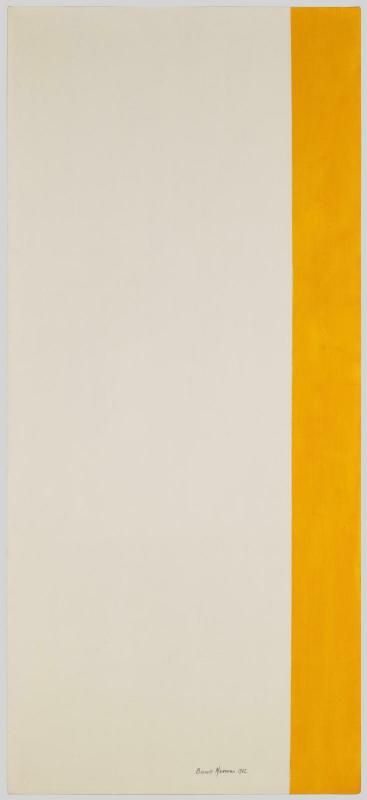
In America Matisse was already known and loved from the interwar years. But in the 1940s his reception underwent a remarkable second birth — thanks to a new generation of abstractionists. Among them Barnett Newman, who also turned the painting into physical presence rather than image of something. In France Raymond Hains and Jacques Villeglé in their film Pénélope literally set Matisse in motion — trying in their own way to go beyond traditional painting. And apart from direct influence — the Algerian self-taught artist Baya: her compositions with dense pattern filling the whole plane echo Matisse's late still lifes.

When I speak of cutting directly into colour, I think of a sculptor's work in stone.
Henri Matisse, on the cut-paper gouache method

Key works

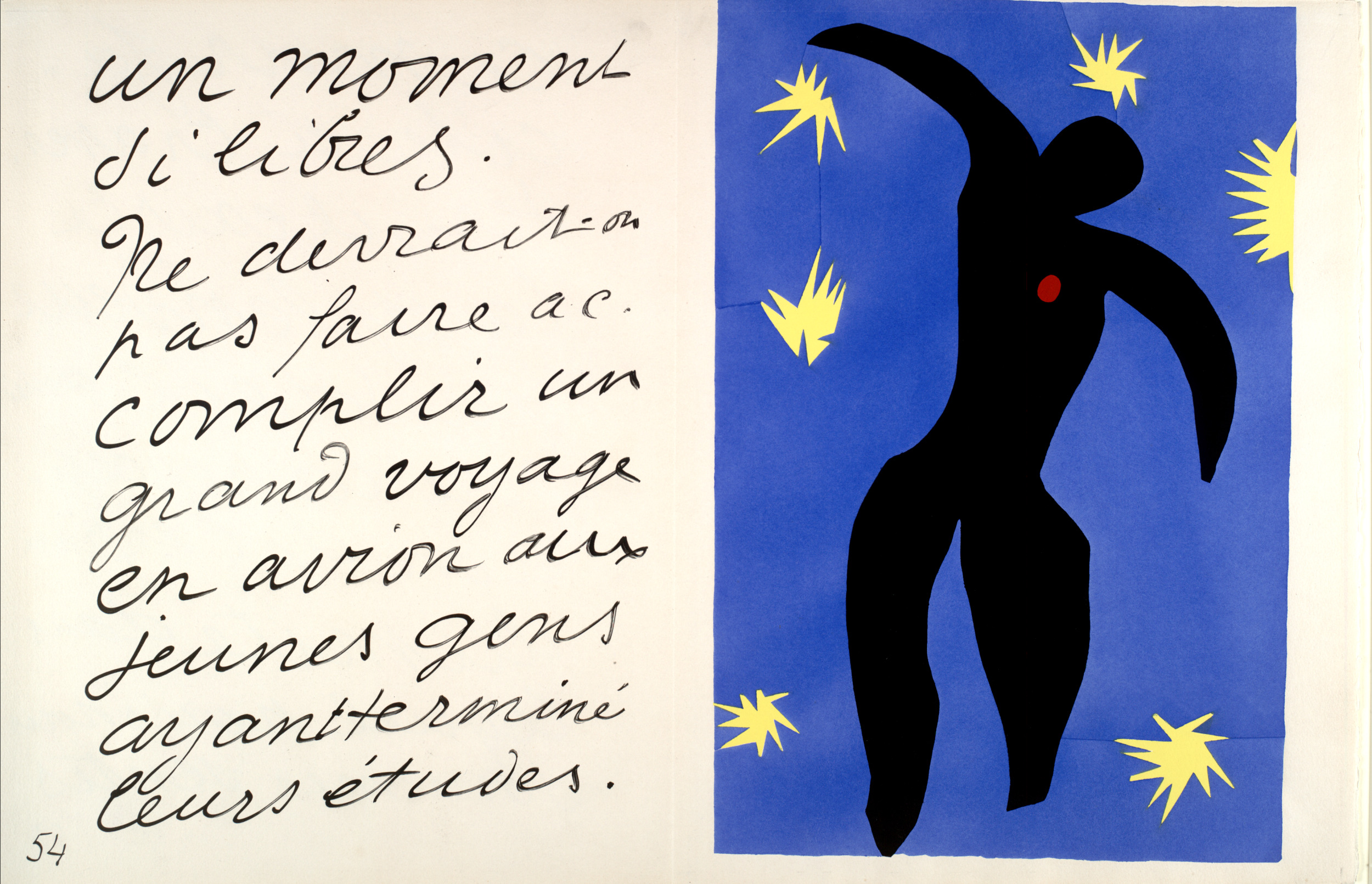
Henri Matisse. Icare, plate VIII from Jazz. 1947
Buffalo AKG Art Museum · public reproduction

Henri Matisse. Icare, plate VIII from Jazz

“Icarus” · 1943—1947 (published 1947) · Pochoir after cut-paper gouache, paper · 42.2 × 32.6 cm · Éditions Tériade

In 1943 publisher Efstratios Tériade commissioned an illustrated book from Matisse. After surgery in 1941 the artist was confined to a chair and could no longer stand at the easel — but found a new tool: scissors. On large sheets pre-painted with gouache he cut figures and colour shapes directly with scissors and then arranged them in composition. The resulting book of 20 plates appeared in 1947 in an edition of 250 copies. The edition was printed in pochoir — a stencil technique where each colour is applied through a separate template; this preserved the density and saturation of the original gouache. Icare is the eighth plate of the book: a falling bird-man with a red dot of heart in a black silhouette against yellow flashes and starry sky. One of the most piercing pages: the ancient myth of the fall made almost like a child's collage — but with the weight of death passed through the war (the book was conceived during the occupation). After Jazz the cut-paper gouache method became Matisse's main one until the end of his life. In Gallery VII the entire series of 20 plates is exhibited in full.

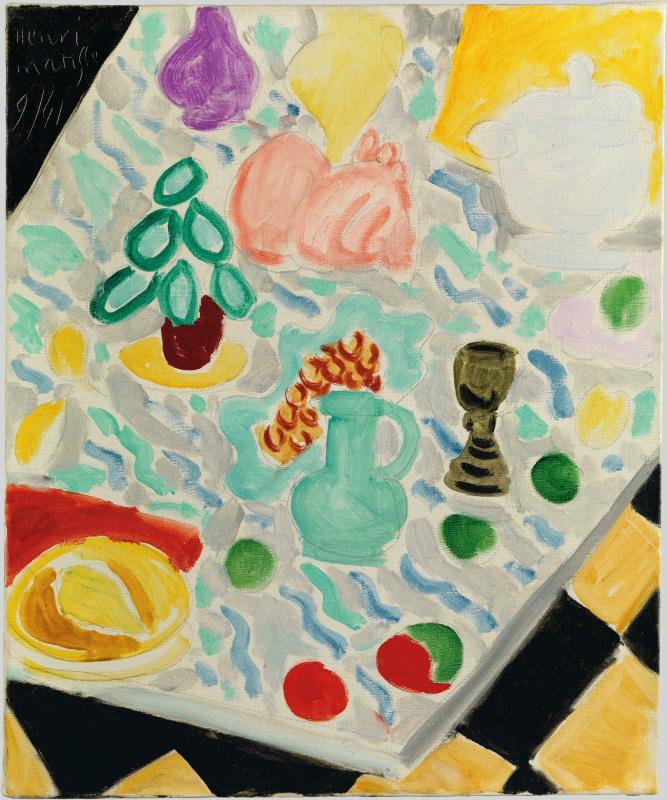
Henri Matisse. Nature morte à la table de marbre vert. 1941
Centre Pompidou (acquisition 1945)

Henri Matisse. Nature morte à la table de marbre vert

“Still Life on a Green Marble Table” · September 1941 · Oil on canvas · 46 × 38.5 cm · Centre Pompidou

Painted in Nice in autumn 1941, immediately after surgery for intestinal cancer that permanently changed Matisse's physical working regime. On green marble painted in schematic strokes are arranged a jug, glass, bowl of fruit, pears, lemon — each object reduced almost to a sign. Matisse called this work his diapason — tuning fork: “everything that grips in it is of the order of music”. Modest size (46 × 38.5 cm), but in it you see the step Matisse would take next: refusal of modelling, flat local colour, contour become the main structural element. This is already almost the vocabulary of future cut-paper gouaches, but still within traditional oil technique. The painting was bought by the state in 1945 and has been in the MNAM collection since.

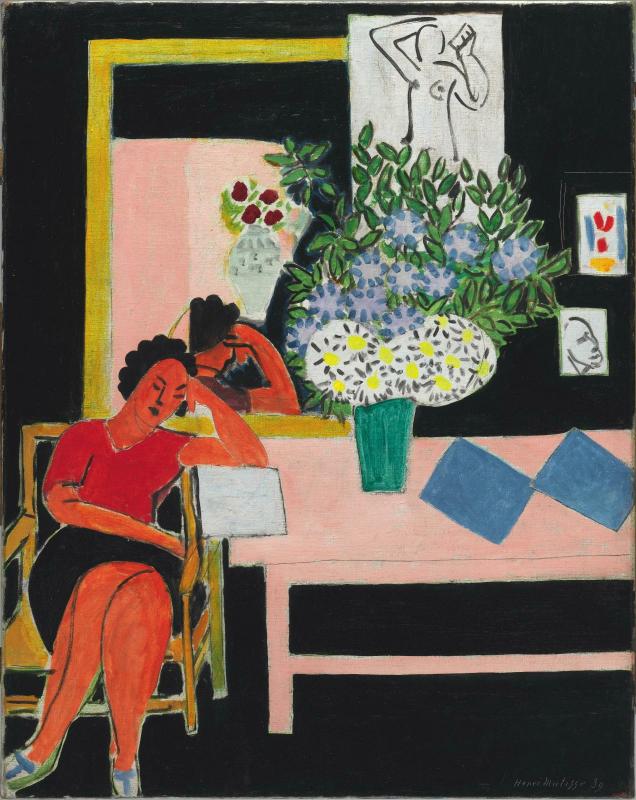
Henri Matisse. Liseuse sur fond noir. 1939
Centre Pompidou

Henri Matisse. Liseuse sur fond noir

“Reader on a Black Ground” · summer 1939 · Oil on canvas · Centre Pompidou

Painted in Paris in summer 1939 — two months before the start of the Second World War and at the most anxious moment of the interwar pause. A young woman in a red dress sits at a table reading; before her a bouquet of daisies and scabiosa in a green vase, in the mirror behind — her reflection and the figure of a nude model from the studio, turned into a sign on a black ground. The composition Matisse calls homogeneous space gathers elements from different “universes” (real room, reflection, drawing on the wall, two blue squares as colour samples) into one plane where they become equal. The black ground is not threatening — it works like a theatrical pause on which the red figure, green vase, white bouquet are lit. This work is a transitional moment: all the Nice decorativeness of the 1920s—30s is already reduced, everything superfluous cut away, and only one decade remains until the first major cut-paper gouache (La Tristesse du roi, 1952).

Neighbours in the gallery

Barnett Newman

1905—1970

American Abstract Expressionist; his “zip” — a vertical colour stripe cutting through a monochrome field — is the same device as in Matisse's cut-paper gouaches: colour as an independent gesture, not description.

Raymond Hains & Jacques Villeglé. Pénélope

film, 1950s

French affichistes of the Nouveau Réalisme group made a short film in which frames of Matisse gouaches are shown through a distorting lens — a literal attempt to “set Matisse in motion”.

Le Corbusier. Métamorphose du violon

1928 / 1952

Architect-artist returns to a 1928 canvas a quarter-century later: Cubist still life with pipe and red heart-dots, redrawn on top — parallel to Matisse's logic of late reduction of form.

Baya Mahieddine. Guitares et paons, Guitares et corne d'abondance

1976

Algerian self-taught artist, discovered in 1947 by Aimé Maeght in Paris; Breton and Dubuffet wrote about her enthusiastically, Picasso invited her to work in Vallauris. Her gouaches with guitars, peacocks, fish on black ground are gathered into an almost carpet-like plane — parallel to late Matisse: the same refusal of depth for decorative density, the same all-over. But if Matisse arrived at this simplicity through sixty years of work, for Baya it was an organic starting point.

Biographical notes

Baya Mahieddine

Bordj el Kiffan, 1931 — Blida, 1998

Algerian self-taught artist, orphan from age five, worked in the garden of French artist Marguerite Caminat, who gave her paper and paints. At 16 — first exhibition in Paris at Aimé Maeght's (1947). Breton, Camus, Dubuffet wrote about her; in 1948 Picasso invited her to work in his ceramic workshop in Vallauris. Long marriage (1953—1982) interrupted her creative activity, but in the 1970s she returned with the same recognisable language. Today — national icon of Algeria and one of the key figures of “art brut” (in Dubuffet's terms) or Arab/Berber modernist tradition.

Efstratios Tériade

Lesbos, 1897 — Paris, 1983

Greek-French art publisher and dealer, founder of the magazine Verve (1937—1960) and the eponymous publishing house. Commissioned livres d'artiste from the greatest artists of the twentieth century: Matisse (Jazz, 1947; Pasiphaé, 1944), Picasso, Chagall, Léger, Miró, Braque. His publishing house set the standard for French avant-garde book graphics: pochoir, lithography, woodcut — each time seeking exact correspondence between medium and the artist's plastic task.

Gallery

“Chez Matisse”: Multiple Horizons

1961 — 1970

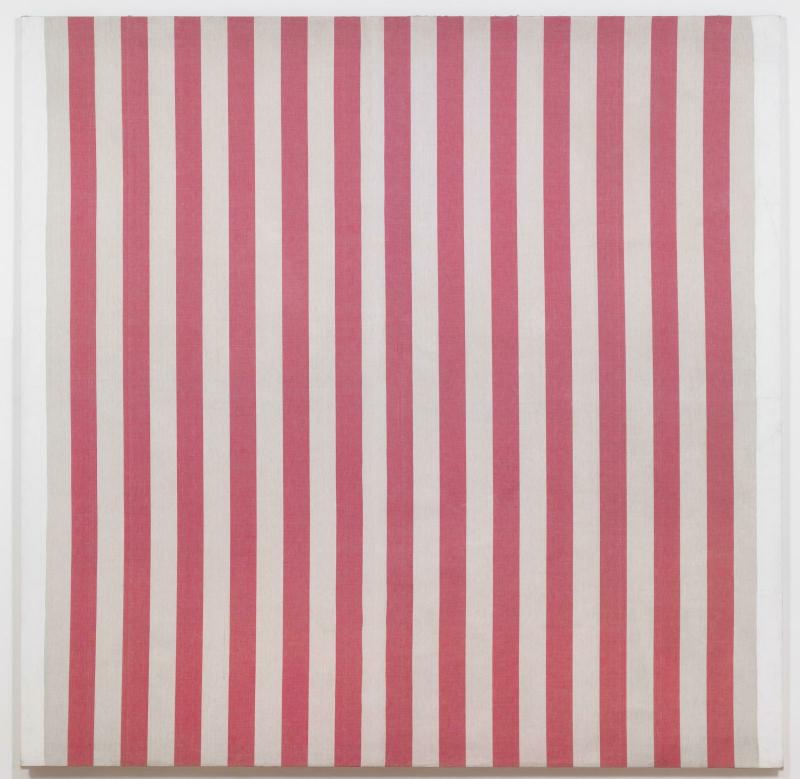
In 1961 the exhibition Henri Matisse. Les grandes gouaches découpées opened at the Musée des Arts décoratifs in Paris — 42 cut-paper gouaches, tapestries and projects for the chapel in Vence, Matisse's last architectural commission, which occupied him until his death in 1954. Young artists Daniel Buren and Michel Parmentier saw this exhibition. One thing struck them about Matisse: how he worked with emptiness between figures and with unpainted white ground — treating them as full parts of the picture, not “void”. But their own conceptual views quickly led Buren and Parmentier away from any emotion towards a strict impersonal protocol: 38 cm stripes for Parmentier, 8.7 cm for Buren.

Other responses are closer to open homage: Jean-Michel Meurice's flag-collage of vinyl fabric or Alain Jacquet's painting Camouflage H. Matisse Luxe, Calme et Volupté, which overlays the famous Matisse canvas with a camouflage pattern in the spirit of Pop Art. Gallery VIII is no longer Matisse himself but Matisse as a point of attraction around which the next generation gathers: some to continue, others to break through and close off.

What I seek from colour is not to describe an object but to make its presence inevitable.
Henri Matisse, late notes

Key works

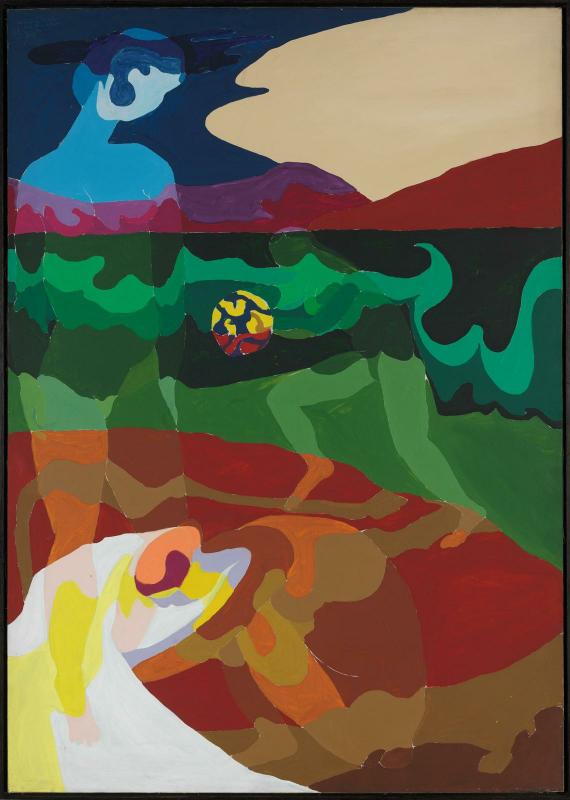
Alain Jacquet. Camouflage H. Matisse Luxe, Calme et Volupté. 1963
Centre Pompidou (acquisition 2011)

Alain Jacquet. Camouflage H. Matisse Luxe, Calme et Volupté

“Camouflage H. Matisse ‘Luxury, Calm and Pleasure’” · spring 1963 · Oil on canvas · 203 × 144 cm · Centre Pompidou

Alain Jacquet (1939—2008) — one of the founders of French Mec Art (“mechanical art”), a direction in which artists work not with a brush but with printing and mechanical processes. In 1962—1964 Jacquet made a Camouflages series: he took famous masterpieces and overlaid them with camouflage pattern. In spring 1963 he took on Matisse's Le Luxe I (1907 — it is in Gallery II). The idea: on an “imperfect copy” of the Matisse canvas camouflage is laid, its colours matched to those of the original. The result is a riddle: to see Matisse you must make him out through the masking grid — and the masking itself consists of the same Matisse colours. Pop Art meets conceptual critique of the museum canon here: the “holy” Matisse turned into military fabric or wallpaper. The painting size almost matches the original (203 × 144 against 210 × 138 cm) — Jacquet literally “takes the place” of the classic. Acquired by the Centre Pompidou in 2011.

Daniel Buren. Peinture, Manifestation III. 1967
Centre Pompidou

Daniel Buren. Peinture, Manifestation III

“Painting, Manifestation III” · June 1967 · Cotton awning fabric with 8.7 cm vertical stripes, white paint · Centre Pompidou

A painting-object exhibited during the third “Manifestation” of the BMPT group (Buren, Mosset, Parmentier, Toroni) in June 1967 at the Musée des Arts décoratifs theatre — characteristically, in the very museum where six years earlier Matisse's landmark exhibition Les grandes gouaches découpées had taken place. Buren took ready-made awning fabric with regular 8.7 cm vertical stripes and painted two outer stripes white — that is the “work”. The BMPT quartet hung the painting on stage instead of a curtain; viewers waited 45 minutes, then learned from a leaflet that the performance had been running all that time. Buren's conceptual gesture connects to Matisse's legacy through the idea of “active whiteness of support”: both Matisse and Buren see untouched ground as an independent pictorial element, not neutral void. But if for Matisse white is space for gesture, for Buren it is a generalised “sign of painting” altogether.

Barnett Newman. Not There — Here. 1962
Centre Pompidou

Barnett Newman. Not There — Here

“Not There — Here” · 1962 · Oil and casein on canvas · Centre Pompidou

One of the leaders of American Abstract Expressionism. His signature device — the zip, a vertical stripe cutting through a colour field. Here — a large white canvas with a single ochre stripe along the right edge. The enigmatic title “Not There — Here” refers to a “non-place” suited to contemplation; by another reading it describes the stripe's position — not in the centre but to the side. The link with Matisse is not direct but structural: Newman saw Matisse's Porte-fenêtre à Collioure (1914 — it is in Gallery IV) at the Art Institute of Chicago and himself said Matisse's central black rectangle gave him a model of “colour field as presence”. Vertical stripe, shift of composition to the side, open neutral field — all of this can be read as Newman's response across the Atlantic to the radical step Matisse took and immediately retreated from.

Neighbours in the gallery

Jean-Michel Meurice

1938—2022

French artist; his “flag” — a large collage of red-white striped vinyl fabric — homage to Matisse's colour flatness through Pop Art material.

Michel Parmentier

1938—2000

BMPT accomplice, beside Buren; worked with 38 cm stripes — programmatically wider than Buren's; conceptual refusal of the “artistic gesture”.

Chapelle du Rosaire, Vence

1948—1951

Matisse's last architectural commission: a total project (stained glass, frescoes, liturgical vestments) he considered the main work of his life. In Gallery VIII represented through projects and sketches.

VERVE 35—36

1958

Final issue of Tériade's magazine with Matisse cut-paper gouache cover — a posthumous summary of late Matisse vocabulary.

Biographical notes

Alain Jacquet

Neuilly-sur-Seine, 1939 — New York, 2008

Artist between Pop Art and Mec Art (mechanical art). After the Camouflages series (1962—1964) he turned to photomechanical processes: his Déjeuner sur l'herbe (1964) — an enlarged typographic halftone after Manet — became an icon of European Pop Art. From the early 1970s he lived between Paris and New York; worked with satellite images of Earth, reflecting on scale and materiality of image in post-media culture.

Daniel Buren

Boulogne-Billancourt, 1938

French conceptual artist; in 1965 he found his “visual tool” — alternating vertical stripes 8.7 cm wide — and has not changed it throughout his career. His installations are built into architecture (the best known — Les Deux Plateaux in the courtyard of the Palais-Royal in Paris, 1986). The main question of his work — boundaries between “work” and “place”, between painting and wall, between showing and concealing. Winner of the Praemium Imperiale (2007), Golden Lion of the Venice Biennale (1986).

In my own words

A hundred years ago Matisse did a simple thing that still works: he understood that colour is not “colouring in” form but an independent language that can speak louder than subject. After him you could no longer paint “as before” — not in Paris, not in Dresden, not in Moscow, not in New York. This exhibition shows how through one person's one decision the whole twentieth century was rewritten.

What you need to know before you go — nothing. You can arrive knowing nothing about modernism and leave understanding how and why it happened. The works are hung so that each gallery answers a separate question: how is Fauvism different from Impressionism? How does war change the picture? What does a woman's gaze do to still-life tradition? Why is a black square in a window about light?

Eight galleries, two hours of unhurried walking, around a hundred works — and you come back with the feeling that the main plot of twentieth-century painting has become clear.

Five reasons not to miss it

  • This is a rare opportunity. The Centre Pompidou in Paris is closed for renovation from September 2025 to 2030 — all these 95 works are temporarily unavailable at home. Barcelona is one of the few cities they have been sent to.
  • This is not a one-artist show. It is not only Matisse — but his conversation with contemporaries: Picasso, Goncharova, Derain, Bonnard, Baya, Buren, Barnett Newman. You see how one person reprogrammed the twentieth century.
  • The real icons are here. Luxe, calme et volupté (1904), Marguerite au chat noir (from the exhibition cover), Porte-fenêtre à Collioure (Matisse's most abstract painting), the entire Jazz cut-paper gouache series in full.
  • The route is organised by ideas, not dates. Each gallery is a separate turn of thought: colour, emotion, war, the south, late light. No art-history background needed — it all reads clearly.
  • At your own pace. Want to move fast — an hour will do. Want to go slow — three hours easily. These notes are to prepare beforehand or consolidate afterwards.

Practical info

Where
CaixaForum Barcelona
av. de Francesc Ferrer i Guàrdia 6—8
metro Espanya
When
27 March — 16 August 2026
daily 10:00—20:00
Ticket
6 €
free with la Caixa card
Allow
1.5—2 hours for a quick visit
3 hours for a slow one
Bring
headphones for the audio guide (free via QR)
phone for photos (allowed everywhere, no flash)

Sources and acknowledgements

Exhibition: “Chez Matisse. The Legacy of a New Approach to Painting”, CaixaForum Barcelona, 27 March — 16 August 2026. Curatorial team Centre Pompidou and Fundación “la Caixa”.

Section texts translated and adapted from the English version of the official exhibition website (sites.fundacionlacaixa.org). Art-historical commentaries on works and biographical notes are original.

Reproductions from Wikimedia Commons and the Centre Pompidou; legal status — public domain (Matisse entered the public domain in most EU jurisdictions on 1 January 2026, 70 years after the artist's death).